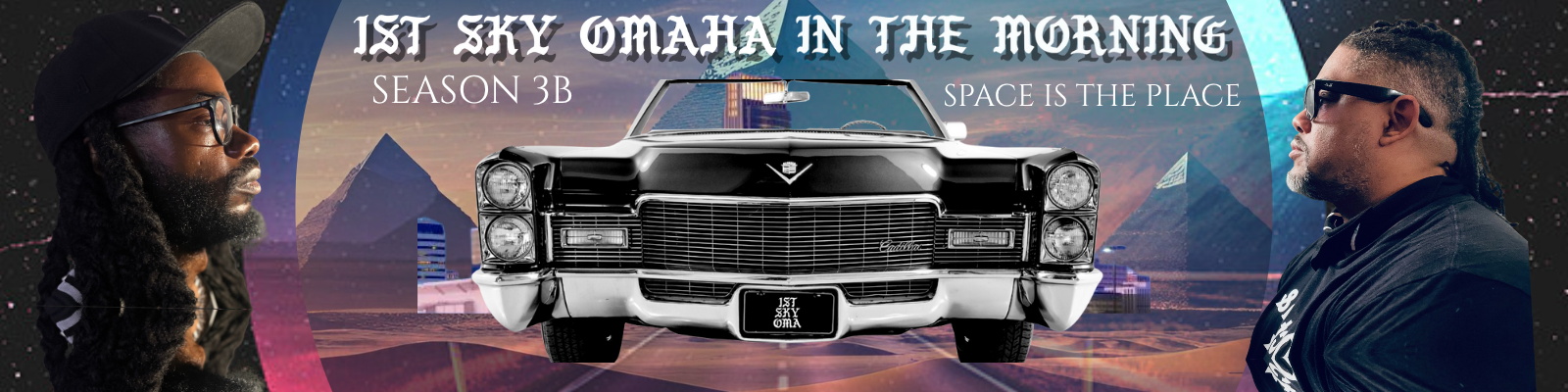
It was a Love Supreme Friday on 1st Sky Omaha in the Morning, and hosts Paul B. and Buddy the God brought the kind of conversation that sticks with you long after the stream ends. From a sobering look at Nebraska’s primary election numbers to a deeply inspiring sit-down with a musician and educator reshaping the future of North Omaha, Season 4, Episode 53 was exactly the kind of show that reminds you why community media matters.
The morning opened with the hangover of Tuesday’s primary results still fresh. Paul B. shared a post from Raquel Henderson of the mayor’s office that stopped the room cold: “Only 339,000 out of more than 1.2 million registered voters in Nebraska showed up yesterday. Posting on Facebook is not enough. Awareness without action changes nothing.” Buddy the God didn’t mince words either. “None of that really matters if the people don’t vote,” he said, “and as I’ve been listening to conversations, that’s a pretty valid point — a lot of this doesn’t matter if everybody voted.”
The chat had plenty to say too. Viewer Kimber Snipes offered a nuanced take: “I’ve been having conversations with people between the ages of 20 and 35. What I hear the most is most of them don’t really know what to do and know nothing about the candidates. I don’t think we should be slamming people for not voting when the system is really what has caused this. I think we need to have more education and deep dive discussions.” It was a sentiment that helped steer the show toward its larger theme of the morning — not just political power, but community power in all its forms. As Paul B. put it, “Political power is one lane and we talk about several different kinds of lanes — this lane of coalition building is where we’re headed next.”
That spirit carried right into the show’s headline interview with Dana Murray, founder and executive director of the North Omaha Music Academy — known to many as the former Love’s Jazz — situated on the storied North 24th Street corridor. Murray, a South Omaha native who spent eleven years as a working musician in New York City before returning home, has quietly built something extraordinary in the heart of a neighborhood that, as he put it, too often fails to showcase its own greatness.
“The arts are the core of who we are as people — definitely as black people — and the history of North Omaha,” Murray said. “There’s so much shared history from North Omaha and South Omaha, and with a lot of the development going on, very little is talked about the social, people development, and healing that has to happen to even take advantage of all the opportunities.”
Murray’s vision for NMA goes well beyond a music school. Students don’t just learn to play instruments — they learn live sound engineering, podcast production, and broadcast skills in a working studio environment. “It’s not just telling them they can be this — no, they can be this right now,” he said. “Once you remove those barriers, sky’s the limit.” That philosophy resonated powerfully with viewer Senator KML, who wrote simply: “Thank you, Uncle Dana. You’re changing lives in big ways. We are the students.”
The conversation grew even bigger when Paul B. asked Murray about the future of North 24th Street — a corridor he has long called “the most important black corner in Nebraska.” Murray laid out a clear-eyed blueprint: sufficient housing, walkable services, transportation access, destination-worthy restaurants and entertainment venues, and — crucially — a hotel that could anchor larger festivals and conferences right in the community. He pointed to Omaha Performing Arts as a model, noting that it generates $40 to $50 million in revenue annually for its district. “We need a vehicle like that for North Omaha,” Murray said, “and I see NMA taking up that space.”
To that end, NMA is planning a capital campaign with a first phase goal of $20 million toward a full NMA campus. Murray was characteristically direct about what’s holding the community back: “Money is not our issue really in North Omaha. It’s transformative ideas that are going to allow us to be not only sustainable but gainfully active.”
On the question of black culture and economics, Murray was equally candid. “Our culture is equity,” he said. “Every music in America has been built off of our experience — from the hardest rock music to the jazziest jazz music to the poppiest of pop music, you trace it all the way back to the music that was brought over here from Africa. The sooner we look at it not as ‘oh, that’s a cool little music thing’ but as equity for us to build and monetize for our community, the better we’re going to be.”
Viewer Pops connected that thread to personal history, noting that artists like Fats Domino once stayed at Paul B.’s grandfather’s home when they came through town to perform — a quiet reminder that North 24th Street’s legacy of Black hospitality and culture runs deep. Paul B. wove that history into his closing reflection on what he calls the “secondary matrix” — the deeper purpose behind every community-building act. “Everything that we do has a secondary meaning, a deeper meaning,” he explained. “In Dana Murray’s case, he teaches kids music — but the secondary matrix is to create critical thinkers.”
The show closed on a high note, with anticipation building for the upcoming NMA Fest, a four-night live music festival benefiting North Omaha Music and Arts, and buzz around the forthcoming film I Love Boosters. Viewer Mark Manor added some extra excitement to the morning, hyping an upcoming Mono Neon performance: “He’s bringing one of the last and relevant connections to Prince. Do not miss that.”
And in the midst of it all, there was a moment of pure joy. Viewer Aeros 402 shared the news that his daughter had just given birth to his second granddaughter. “They are both new and good. I feel blessed.” It was a small, beautiful reminder of what Love Supreme Fridays are really about — community, continuity, and the next generation coming into the world.
If Friday’s episode is any indication, 1st Sky Omaha in the Morning is hitting its stride as a true pillar of the community. Tune in Monday — the conversation is just getting started.