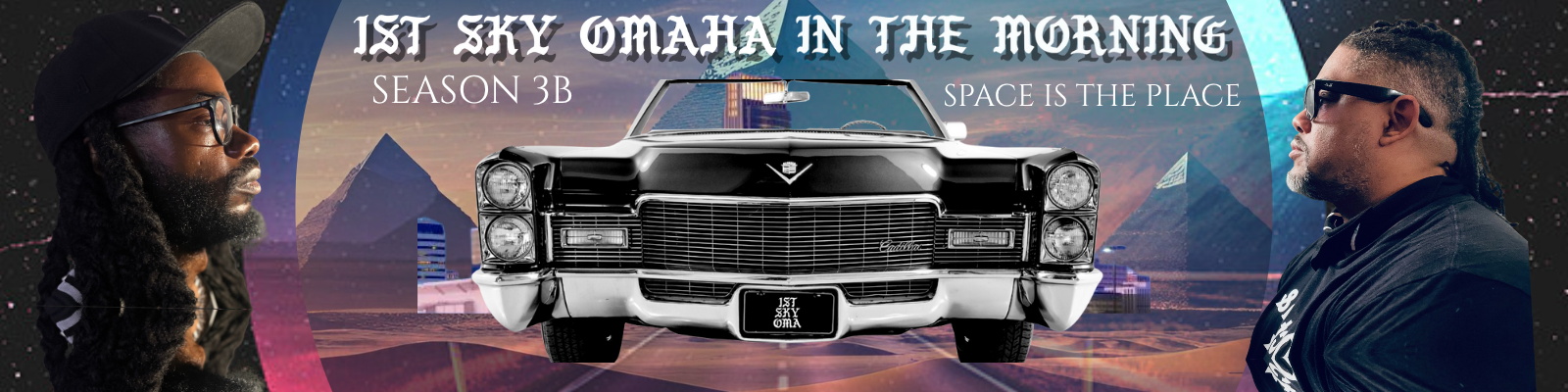
Some Fridays just call for a reset. After a week of charged political conversation — including fallout from Nebraska’s midterm primary results — hosts Paul B. and Buddy the God made a deliberate choice when they opened the May 15, 2026 episode of 1st Sky Omaha in the Morning. They called it “Love Supreme Friday,” and they meant it.
“There’s a lot of chatter going on on Friends of First Sky Omaha,” Paul B. said early in the broadcast. “There’s a lot of back and forth, friends breaking up, all kinds of stuff happening over politics — and that just is like, okay, well, we have to make a decision. It’s going to be Love Supreme Friday today.” The audience felt it immediately. Viewer Judy Princ put it simply in the chat: “If you are sad or angry, go out and help others. Your attitude will change.” And over in a quieter corner of the feed, viewer Aeros 402 shared a moment that needed no political context at all: “On a love note, my only daughter gave birth to my second granddaughter. They are both new and good. I feel blessed.”
The primary results weren’t ignored entirely. Buddy the God reflected on the broader stakes of civic participation, noting what had been echoing through community conversations all week. “None of that really matters if the people don’t vote,” he said, “and as I’ve been listening to conversations, it’s a pretty valid point that a lot of this doesn’t matter if everybody voted.” Viewer Sean McCarthy offered some grounding numbers, sharing that the Douglas County Election Commissioner had reported average primary voter turnout at around 35 percent. The hosts acknowledged it and moved forward — because moving forward was the whole point of the day.
That forward momentum found its fullest expression in the morning’s main interview: a wide-ranging conversation with Dana Murray, executive director and co-founder of the North Omaha Music Academy (NMA), located on North 24th Street. Murray — a South Omaha native who spent eleven years in New York City before returning home — has been teaching music in Omaha for two decades. But as the conversation quickly revealed, music is really just the front door.
“We’re not only raising musicians but, more importantly, raising more critical-thinking human beings,” Murray said, “because these young kids are not all going to become musicians. Some will become doctors, lawyers, business owners — and whatever they choose, they’re going to be better because they were aligned with artistry. It opens up their curiosity, their ability to set a high bar for themselves, and to be accountable.”
Paul B. framed it through a concept he calls the “secondary matrix” — the deeper purpose running beneath the surface of any meaningful work. “Everything you’re doing really does kind of have a secondary matrix,” he explained. “In Dana Murray’s case, he teaches kids music — but we all know that when you learn music, your brain synapsis starts firing in different ways. You become a better student, more intelligent. The secondary matrix for him is to create critical thinkers.”
NMA’s programming goes well beyond instrument instruction. Murray described electives in live sound engineering, broadcasting, and podcasting — including a broadcast lab where students conduct real interviews with visiting artists. “It’s not just telling them, ‘Oh, you can be this,'” Murray said. “No — you can be this right now.” That hands-on philosophy extends to how NMA recruits instructors. Murray emphasized that technical knowledge alone isn’t enough. “Anyone can have the X’s and O’s of teaching, but unless you’re able to inspire a young person, they don’t really have the attention span for the X’s and O’s of music. The why you’re doing it is everything — because they don’t need us for the what. They can go to YouTube and see anything we’re trying to teach them.”
The conversation turned to the larger vision Murray holds for North 24th Street — a corridor Paul B. has long called “the most important Black corner in Nebraska.” Murray was candid about both the potential and the missed opportunities. “At every opportunity, we fail at taking advantage of showcasing our culture,” he said, pointing to events that draw community together but don’t always invite the wider city in. “One of the things I’ve tried to do was reach out and be a beacon for all of Omaha to come down to North 24th Street. People told me that was going to be very hard — but people have no problem coming from wherever they are in Omaha or Iowa to come down North 24th Street to hear jazz music.”
His long-term ambition is nothing short of transformational. Murray envisions NMA growing into a full campus anchored by a $20 million capital campaign — a cultural and economic engine for North Omaha modeled on what Omaha Performing Arts has done for downtown. “What we have to sell in most Black communities is our culture,” he said. “The sooner we understand that our culture is equity — that our brilliance, our artistic genius is equity — the better off we’re going to be.” Viewer Senator KML said it plainly in the chat: “Thank you, Uncle Dana. You’re changing lives in big ways. We are the students.”
The show closed on a note as communal as it began — with mentions of Heart Ministry Center’s forthcoming grocery store, the upcoming four-night NMA Fest, and Boots Riley’s film I Love Boosters. Buddy the God summed up the season’s recurring theme with characteristic directness: “We got to do both. We got to build our own ecosystems and continue to do the things we’re about to talk about. But in the long run, we do got to figure this out as a nation.”
Music educators interested in joining the NMA team can reach Dana Murray at dmurray@northomahamusic.org or assistant Andrew Bailey at abailey@northomahamusic.org.
It was, by any measure, a Love Supreme kind of Friday. Tune in Monday morning — the conversation is always worth showing up for.