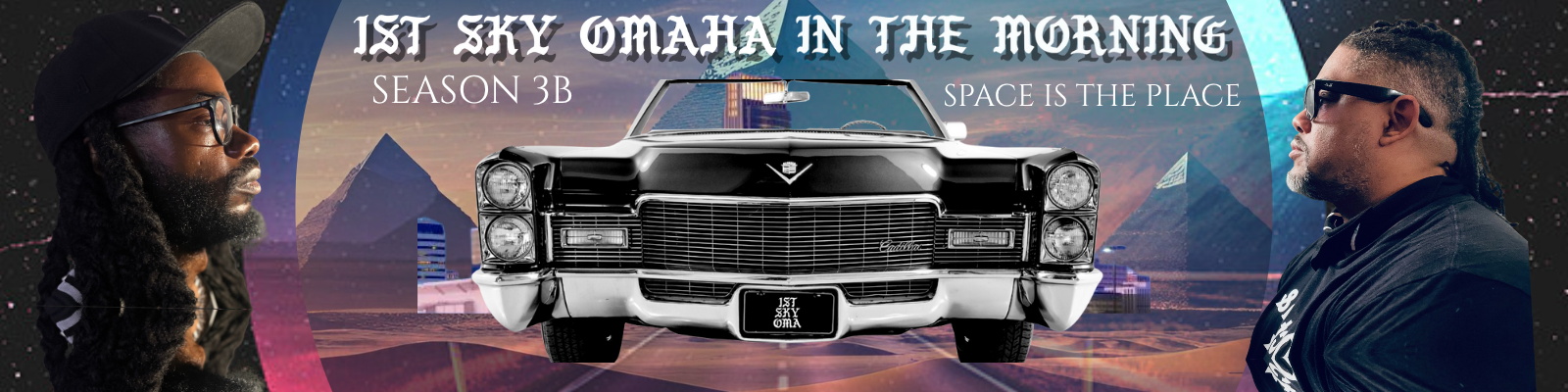
It was a Love Supreme Friday on 1st Sky Omaha in the Morning, and hosts Paul B. and Buddy the God were determined to set the right tone from the jump. “We have to make a decision,” Paul B. told viewers. “It’s going to be Love Supreme Friday today. And we’re going to change our mindsets over to something else — use music, use whatever it is that you need to use to get your head straight.” With that, the show rolled into one of its richest episodes of the season — part civic conversation, part community celebration, and part master class in what it means to invest in the next generation.
The morning opened with a warm moment from the live chat. Viewer Aeros 402 shared the news that his only daughter had just given birth to his second granddaughter, writing, “They are both new and good. I feel blessed.” It was exactly the kind of joy that sets a Love Supreme Friday apart, and the hosts leaned right into it.
From there, Paul B. and Buddy the God turned to the topic of Nebraska’s midterm primary results and the broader question of civic engagement — a conversation that felt both urgent and grounded. Buddy the God framed the challenge plainly: “None of this really matters if everybody voted. The data they use to draw even the gerrymandered racist maps is still based on who’s registered, who’s of age, and actually who comes out to vote.” Viewer Kimber Snipes added a nuanced layer to the discussion, writing that in her conversations with people between the ages of 20 and 35, “most of them don’t really know what to do and know nothing about the candidates,” and pushing back on the idea of shaming non-voters. “I think we need to have more education and deep dive discussions,” she wrote — a sentiment the hosts received with respect and agreement.
But the heart of the morning belonged to the show’s featured guest: Dana Murray, executive director and founder of the North Omaha Music Academy (NMA). Born in South Omaha, Murray spent eleven years building his craft in New York City before returning home to plant something lasting on North 24th Street. What he’s built — formerly known as Love’s Jazz — is a youth music academy, a performance venue, and by any honest measure, a community anchor.
Murray spoke with the quiet confidence of someone who has already proven the skeptics wrong. When the hosts raised the vision for the North 24th Street corridor — what Paul B. has long called “the most important Black corner in Nebraska” — Murray didn’t mince words. “Really, the area that has the most history and the one that can claim it is a cultural and arts district for real is the North 24th Street corridor,” he said. “And we’ve been so far removed from that — not even what the rest of Omaha views it as. I’m more talking to the people that are there, who are so far removed from what that was, that it is hard to build momentum from within.”
He laid out a clear-eyed framework for what a thriving district actually requires: housing density, parking, laundromats, grocery stores, gas stations — the unsexy infrastructure that makes everything else possible — alongside destinations like restaurants, lounges, and entertainment. “It would be great to have a hotel,” Murray said. “With a hotel, now you can throw larger attractions, music festivals, conferences right in the community.” Viewer Pops echoed the sentiment from personal history, recalling that artists like Fats Domino once stayed at Paul B.’s grandfather’s home when they came to town to perform. “More infrastructure for the artist around the Deuce corridor would be a godsend,” Pops wrote.
On the question of his own place in the North Omaha ecosystem — given that he grew up in South Omaha — Murray was reflective and direct. “If you’re Black and you’re in Omaha, especially in the 70s and early 80s, everyone had a shared relationship with North Omaha. That was the Mecca for us.” He spoke candidly about what he sees as missed opportunities to showcase the community’s culture to the wider city. “One of the things I’ve tried to do is reach out and be a beacon for all of Omaha to come down to North 24th Street,” he said. “People told me that was going to be very hard. And people don’t have any problem coming from wherever they are in Omaha or Iowa to come down and hear jazz music. That taboo about the area and its ability to be an attraction was false. We’ve proven that.”
The conversation turned to what NMA is actually doing for young people — and here, Murray’s vision came into sharpest focus. “We’re not only raising musicians, but more importantly we’re raising more critical-thinking human beings,” he said, “because all these young kids are not going to become musicians by choice. Some will become doctors, lawyers, business owners. Whatever they choose to do, they’re going to be better because they were aligned with artistry.” Paul B. put his own frame around it, describing what he calls the “secondary matrix” — the idea that everything NMA does carries a deeper purpose. “He teaches kids music,” Paul B. explained, “but the secondary matrix is to create critical thinkers.”
Murray described a program that goes well beyond scales and sheet music. Students learn live sound engineering, broadcast production, and live streaming. NMA has a podcast and broadcast lab where kids conduct interviews with visiting artists. “It’s not just telling them ‘you can be this,'” Murray said. “No — you can be this right now. Once you remove those barriers, the sky’s the limit.” He also spoke passionately about the role of context and legacy, teaching students about Omaha-born legends like Buddy Miles and Victor Lewis. “If you give kids context, they connect the dots for themselves and they start to see the wins and the losses, and then they can see how they can be impactful within that ecosystem.”
Looking ahead, Murray shared that NMA is preparing to launch a capital campaign — with a first phase goal of $20 million — aimed at building a full NMA campus on the North 24th corridor. “What we have to sell in most Black communities is our culture,” he said. “If we don’t monetize it — and 99% of the time we don’t — the rest of the country monetizes our culture for us. Our culture is equity. Our brilliance, our artistic genius is equity, and the sooner we look at it that way and not as ‘oh, that’s a cool little music thing,’ the better we’re going to be.”
“I love this interview. This brother’s vibe is so cool and his intentions are admirable. First Sky loves the kids.” — viewer Pops
Music instructors interested in joining the NMA team can reach Dana Murray directly at dmurray@northomahamusic.org or his assistant Andrew Bailey at abailey@northomahamusic.org. And for those who want to experience NMA’s work firsthand, the upcoming NMA Fest — a four-night event — is right around the corner. “When I’m comparing festivals, I’m saying this one to me is the one,” Paul B. said. “If I was going to put a festival together, it’d be this — and it’s going to be huge.”
The show closed as it always does — with warmth, community, and a sense that Monday can’t come soon enough. Join Paul B., Buddy the God, and the whole First Sky family next week for another morning worth waking up for.