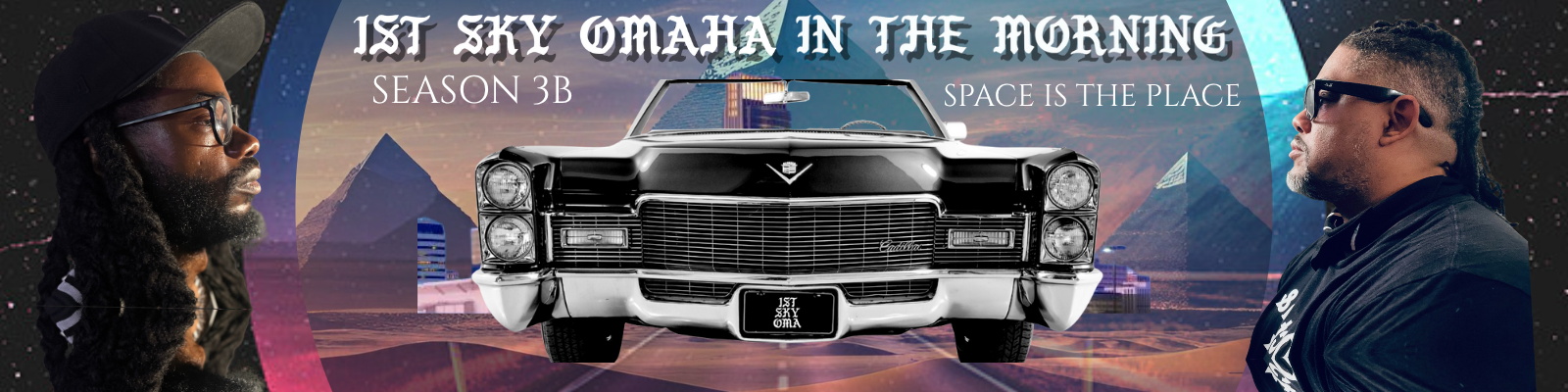
It was a Love Supreme Friday on 1st Sky Omaha in the Morning, and hosts Paul B. and Buddy the God made good on that promise — setting aside the post-primary political noise for something a little deeper, a little warmer, and a whole lot closer to home. The conversation turned toward community, culture, and the kind of grassroots work that doesn’t always make headlines but quietly changes lives.
“We’ve been talking a lot of politics for a while and it’s time for a little break after the primaries,” Paul B. told viewers. “Love Supreme is going down today for sure.” And it did. The show opened with a reflection on civic participation — not just voting, but staying engaged in where community resources actually go. Buddy the God put it plainly: “Don’t pay taxes and see what happens. And if you’re going to pay taxes, then you should at least care about where it’s going and what it’s doing.”
Viewer Kimber Snipes echoed a concern many in the audience seemed to share: “I’ve been having conversations with people between the ages of 20 and 35. What I hear the most is most of them don’t really know what to do and know nothing about the candidates. Politics also seems — because it is — very messy to them.” It was a thread the show would return to throughout the morning: how do you build something meaningful when so many people feel disconnected from the systems around them?
The heart of the episode, though, was a rich conversation with Dana Murray, executive director and founder of the North Omaha Music Academy — NMA for short, formerly known as Love’s Jazz. Murray, a musician and educator who spent 11 years in New York City before returning to Omaha, is doing the kind of work Paul B. describes as operating in what he calls the “secondary matrix.” “Everything that we do has a secondary meaning, a deeper meaning,” Paul B. explained. “In Dana Murray’s case, he teaches kids music — but the secondary matrix is to create critical thinkers.”
Murray, soft-spoken but deeply intentional, didn’t shy away from hard truths about the community he’s trying to serve. Located on North 24th Street — a corridor Paul B. has long called “the most important black corner in Nebraska” — NMA is both a youth music academy and a performance venue. But Murray’s vision extends far beyond music lessons. “We’re not only raising musicians, but more importantly we’re raising more critical thinking human beings,” he said. “Whatever these young kids choose to do, they’re going to be better because they were aligned with artistry.”
Murray drew a compelling parallel to Omaha Performing Arts, noting that the downtown institution generates $40 to $50 million in revenue annually — functioning not just as a cultural hub but as a serious economic engine. “We need a vehicle like that for North Omaha,” he said, “and I see NMA taking up that space.” The academy is planning a capital campaign with a first phase of $20 million, with the long-term goal of building a full NMA campus on the North 24th corridor.
The conversation grew particularly candid when Murray addressed what he sees as a missed opportunity in how North Omaha presents itself to the broader city. Though he grew up in South Omaha, he spoke with authority about the neighborhood’s cultural legacy — and its failure, at times, to share that legacy outward. He pointed to Native Omaha Days as an example: “I love Native Omaha Days at its core — anything that can bring us together. It’s a reunion, but it’s a failed opportunity to showcase our culture because none of that is trying to invite the rest of Omaha down to partake in what we have to offer.” He held up South Omaha’s Cinco de Mayo celebration as a model: “It’s a festival that brings them together, but they invite everybody down to be part of that. I wish we did more of that.”
Viewer Pops responded with a personal note that gave the conversation even more historical weight: “Yes, Paul. Artists like Fats Domino used to stay at your grandfather’s home when he came to town to perform. So yes, more infrastructure for the artist around the Deuce corridor would be a godsend.”
Murray was equally direct about the state of youth education. “We are in a crisis with education — not just young black kids, young kids — because we are losing the ability to inspire them,” he said. “We have to figure out how to inspire them within the world that they live in.” At NMA, that means meeting students where they are, rather than forcing a curriculum he described as “very antiquated for their time.” The academy is also actively seeking music educators — specifically those who can do more than teach scales. “Unless you’re able to inspire a young person, they don’t really have the attention span for the X’s and O’s of music,” Murray said. “The why they’re doing it is everything.” Interested instructors can reach Murray directly at dmurray@northomahamusic.org or his assistant Andrew Bailey at abailey@northomahamusic.org.
NMA Fest, the academy’s upcoming community celebration, promises to be a showcase of exactly the kind of cultural energy Murray is working to cultivate. Details are available through the academy’s channels as the event approaches.
The show closed on a note as warm as it opened. Viewer Aeros 402 shared a beautiful moment mid-broadcast: “On a love note, my only daughter gave birth to my second granddaughter. They are both new and good. I feel blessed.” It was exactly the kind of reminder the show seemed built for — that amid policy debates and capital campaigns and cultural reckonings, the most important things are still the people right next to us.
Buddy the God, as always, kept his eye on the bigger picture: “We got to do both — build our own ecosystems and continue the things we’re about to talk about. But in the long run, we do got to figure this out as a nation.”
If you missed this Friday’s Love Supreme edition of 1st Sky Omaha in the Morning, make sure you’re tuned in Monday morning — because this community conversation is just getting started.