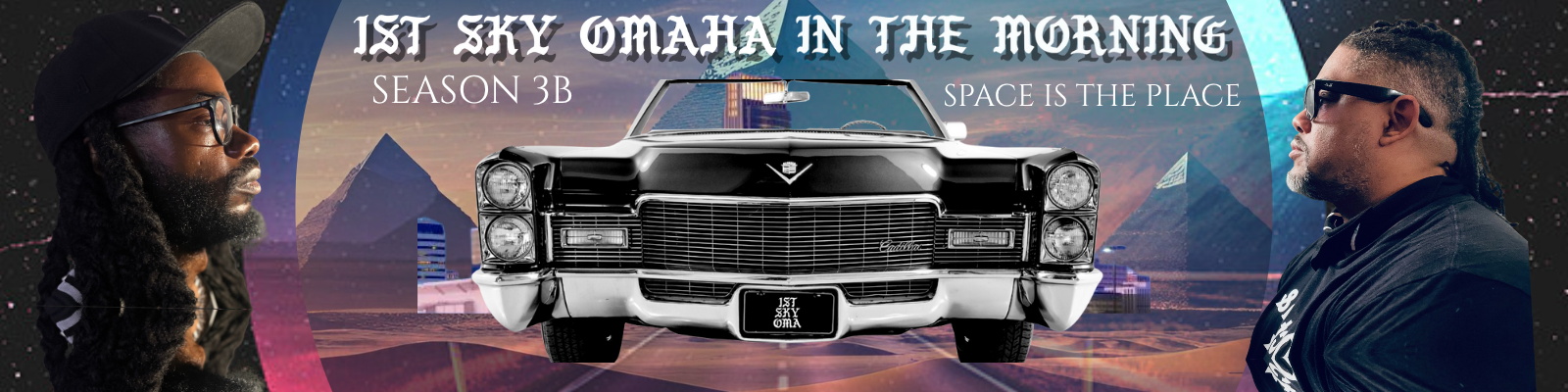
It was a Love Supreme Friday on the set of 1st Sky Omaha in the Morning, and hosts Paul B. and Buddy the God were determined to keep it that way — even as the conversation turned to some heavy realities facing the Omaha community.
The morning kicked off with a reflection on Nebraska’s recent primary elections, where turnout left much to be desired. Viewer Raquel Henderson said it plainly in the chat: “Only 339,000 out of more than 1.2 million registered voters in Nebraska showed up yesterday. Think about that. And yet everybody has something to say. Where is that same energy when it’s time to organize, educate, mobilize, register, and actually vote?” It was the kind of comment that stopped the room cold — and Paul B. and Buddy the God leaned right into it.
Buddy the God put the civic challenge in plain terms: “None of this really matters if everybody voted. That’s a pretty valid point — a lot of this doesn’t matter if everybody voted.” But rather than letting the weight of that reality darken the mood, the hosts pivoted toward something more energizing — the idea that communities don’t have to wait for permission to build.
“We got to do both,” Buddy said, “build our own ecosystems and continue to vote so it can be supported and uplifted rather than undermined by those who are in office. That’s the dichotomy.”
It was Paul B. who framed the show’s deeper purpose with what he called the “secondary matrix” — the idea that every conversation on 1st Sky is pointing toward something larger. “The idea is that there’s always a deeper meaning to what it is that you’re talking about doing,” he said. “The secondary matrix of First Sky Omaha is to build community, build coalition, speak to a family of people that we can regularly talk to and come to some conclusions so we can get to some action.” Viewer Pops echoed the sentiment from personal experience, noting in the chat: “I experienced my secondary matrix in junior high when I took algebra. I was gaining proficiency and noticed I was suddenly able to think outside the box on several different levels. Music the same.”
That thread led perfectly into the morning’s featured guest — Dana Murray, director and founder of the North Omaha Music Academy (NMA), formerly known as Love’s Jazz. A South Omaha native who spent eleven years honing his craft in New York City before returning home, Murray is building something on North 24th Street that he believes could change the trajectory of an entire community.
Murray’s vision for the North 24th Street corridor is both practical and profound. “Really, the area that has the most history and the one that can claim ‘we are a cultural and arts district’ for real is the North 24th Street corridor,” he said. But he was candid about the challenges from within. “There are metrics for the success of any district. You have to have enough housing, places of service, parking, laundromats, eateries, gas stations — all the things any area needs to be self-sustained. And then you have to have destinations: entertainment, restaurants, lounges.” He even floated the idea of a hotel — because, as he put it, with a hotel, you can attract music festivals and conferences right in the heart of the community. “A lot of stuff on North 24th Street wasn’t sustainable. The X’s and O’s have to make sense.”
As a South Omaha native, Murray acknowledged some might question his place in the North Omaha ecosystem — but he addressed it head-on. “If you’re Black and you’re in Omaha, especially in the ’70s and early ’80s, everyone had a shared relationship with North Omaha. That was the Mecca for us.” He pointed to South Omaha’s Cinco de Mayo as a model for what cultural celebration can look like when it opens its arms to the whole city. “One of the things I’ve tried to do was reach out and be a beacon for all of Omaha to come down to North 24th Street. People told me that was going to be very hard. And people don’t have any problem coming from wherever they are in Omaha or Iowa to come down to hear jazz music or whatever we present.”
At its core, NMA is a youth music academy and performance venue — but Murray makes clear it’s about far more than producing musicians. “We’re not only raising musicians but, more importantly, we’re raising more critical thinking human beings,” he said. “Some will become doctors, lawyers, business owners — whatever they choose to do, they’re going to be better because they were aligned with artistry. That opens up their curiosity, their ability to set a high bar for themselves, to be accountable.” He also named brain drain as one of the most devastating forces facing North Omaha, and sees NMA as part of the answer.
The growth plan is ambitious. Murray described a first-phase capital campaign of $20 million, with an eye toward an full NMA campus modeled on the economic engine that Omaha Performing Arts has been for its surrounding area. “We need a vehicle like that for North Omaha, and I see NMA taking up that space,” he said. His message about culture as currency was pointed: “What we have to sell in most Black communities is our culture. Because if we don’t monetize it — which 99% of the time we don’t — the rest of the country monetizes our culture for us. The sooner we understand that our culture is equity, that our artistic genius is equity, the better off we’re going to be.”
NMA is also looking to grow its team of instructors. Murray was clear about the standard they hold: technical skill matters, but inspiration matters more. “They don’t need us for the ‘what’ — they can go to YouTube and see anything we’re trying to teach them. The ‘why’ they’re doing it is everything.” Interested educators can reach Dana Murray at dmurray@northomahamusic.org or assistant Andrew Bailey at abailey@northomahamusic.org.
Viewer Senator KML captured the feeling in the room simply: “Thank you, Uncle Dana. You’re changing lives in big ways. We are the students.” And viewer Pops added a touching piece of history, noting that artists like Fats Domino once stayed at Paul B.’s grandfather’s home when performing in town — a reminder that the legacy of North 24th Street runs deep, and that the work Dana Murray is doing is part of a very long story.
The show also touched on other bright spots in the community — from Charell Shelton’s work at Core Science Bio Diagnostics, to the Heart Ministry Center’s forthcoming grocery store, to Boots Riley’s new film I Love Boosters — all woven together as examples of that same secondary matrix at work: people choosing to build, even when the political winds aren’t at their backs.
Paul B. set the tone for it all early in the morning, and it held straight through to the final segment. “We have to make a decision. It’s going to be Love Supreme Friday today. And we’re going to change our mindsets over to something else — because it’s real easy to let your emotions take over when there’s so much to be emotional about.”
The show closed as it always does — with community. Viewer Aeros 402 shared a personal bright spot: “On a love note, my only daughter gave birth to my second granddaughter. They are both new and good. I feel blessed.” That’s the kind of moment that reminds you what all this building is for.
If you missed this Friday’s show, make sure you’re tuned in Monday morning — because on 1st Sky Omaha in the Morning, the conversation is always worth showing up for.