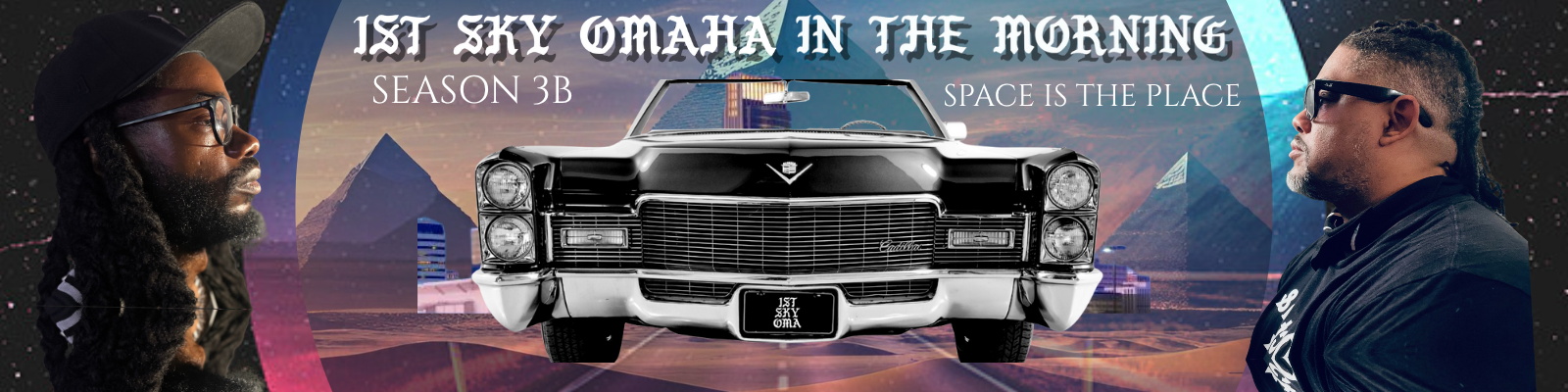
It was a Love Supreme Friday on 1st Sky Omaha in the Morning, and the energy in the virtual studio matched the occasion. Hosts Paul B. and Buddy the God took a deliberate step back from the political noise that had dominated recent weeks and leaned into something more nourishing — a deep, wide-ranging conversation about music, youth, community identity, and the future of North Omaha. At the center of it all was a guest who has been quietly doing the work for years: Dana Murray, executive director and founder of the North Omaha Music Academy (NMA).
Paul B. set the tone right away. “We’ve been talking a lot of politics for a while and it’s got a little break after the primaries — it doesn’t have to dominate the show today,” he said. That said, the post-primary moment wasn’t entirely left behind. Buddy the God offered a candid reflection on the toll that political culture takes on communities. “How ugly it gets, how the energy and just the emotion around people’s policies and politics separate people, drive wedges, cause enemies,” he said. “It’s a dirty ugly game.” Viewer Raquel Henderson (reposted by the hosts) put a finer point on it: “Only 339,320 out of more than 1.2 million registered voters in Nebraska showed up yesterday. Think about that for a second. And yet everybody has something to say. Everybody’s angry. Everybody’s debating policies and leadership decisions online. Where is that same energy when it’s time to organize, educate, mobilize, register, and actually vote?” It was the kind of civic gut-check that lingered in the background even as the conversation shifted toward something more hopeful.
That something was Dana Murray. A South Omaha native who spent eleven years in New York City before returning home, Murray has planted himself firmly on the North 24th Street corridor — a stretch of Omaha with one of the richest cultural histories in the entire region. Formerly known as Love’s Jazz, the North Omaha Music Academy has grown into a full youth arts institution offering music instruction, live sound engineering, broadcasting, podcast production, and performance experience. And Murray has a vision for it that reaches well beyond the current footprint.
“If you think of Omaha Performing Arts and what it means to downtown — not only as a music entertainment entity but as an economic vehicle that brings in $40 to $50 million in revenue every year — that’s what we’re trying to build,” Murray said. “We’re not only raising musicians, but more importantly we’re raising more critical thinking human beings, because all these young kids are not going to become musicians by choice. Whatever they choose to do, they’re going to be better because they were aligned with artistry.”
Paul B. framed this beautifully through what he calls the “secondary matrix” — the idea that everything meaningful has a deeper layer of purpose beneath it. “In Dana Murray’s case, he teaches kids music — but the secondary matrix is to create critical thinkers,” Paul B. explained. Viewer Pops echoed the concept from lived experience: “I experienced my secondary matrix in junior high when I took algebra. I was gaining proficiency. I noticed that I was suddenly able to think outside the box on several different levels. Music the same.”
Murray spoke candidly about the challenges of building momentum in a community that, in his view, has drifted from its own legacy. “The area that has the most history and the one that can claim ‘we are a cultural and arts district’ for real is the North 24th Street corridor,” he said. “And we’ve been so far removed from that — not even what the rest of Omaha views North 24th Street as. I’m more talking to the people that are there, who are so far removed from what that was, that it is hard to build momentum from within when a lot of the community within can’t relate to the power of what was.”
He used Native Omaha Days as a touchstone — honoring its spirit while calling for more. “I love Native Omaha Days at its core — anything that can bring us together,” he said. “But it’s a failed opportunity to showcase our culture because none of that is trying to invite the rest of Omaha down to partake in what we have to offer.” He pointed admiringly to South Omaha’s Cinco de Mayo celebration as a model. “All we have to do is even look at South Omaha’s Cinco de Mayo and how they champion their culture — it is a festival that brings them together, but they invite everybody down to be part of that. I wish we did more of that.”
The good news is that an opportunity is coming. The NMA Fest — a major upcoming event along the North 24th Street corridor — has Paul B. fired up. “When I’m comparing festivals, I’m saying this one to me is the one,” he said. “If I was going to put a festival together, it’d be this — and it’s going to be huge.” Murray also announced that NMA is preparing to launch a capital campaign with a first phase goal of $20 million, aimed at building a full NMA campus that could serve as a transformative economic and cultural anchor for North Omaha. “Money is not our issue really in North Omaha,” he said. “It’s transformative ideas that are going to allow us to be not only sustainable but gainfully active.”
For those inspired to get involved, Murray noted that NMA is actively building capacity — thoughtfully. “Unless you’re able to inspire a young person, they don’t really have the attention span for the X’s and O’s of music,” he said. “The why you’re doing it is everything.” Music educators interested in connecting with NMA can reach Murray at dmurray@northomahamusic.org or assistant Andrew Bailey at abailey@northomahamusic.org.
The show closed on a few warm notes — including a joyful announcement from viewer Aeros 402: “On a love note, my only daughter gave birth to my second granddaughter. They are both new and good. I feel blessed.” The kind of moment that reminds you what community is really about. And viewer Pops said it simply for many in the chat: “Thanks for another great week of shows. You and the Chat Chimers have made First Sky a true pillar in the community.”
That’s Love Supreme Friday in Omaha. Be sure to tune in Monday morning — you won’t want to miss what’s next.