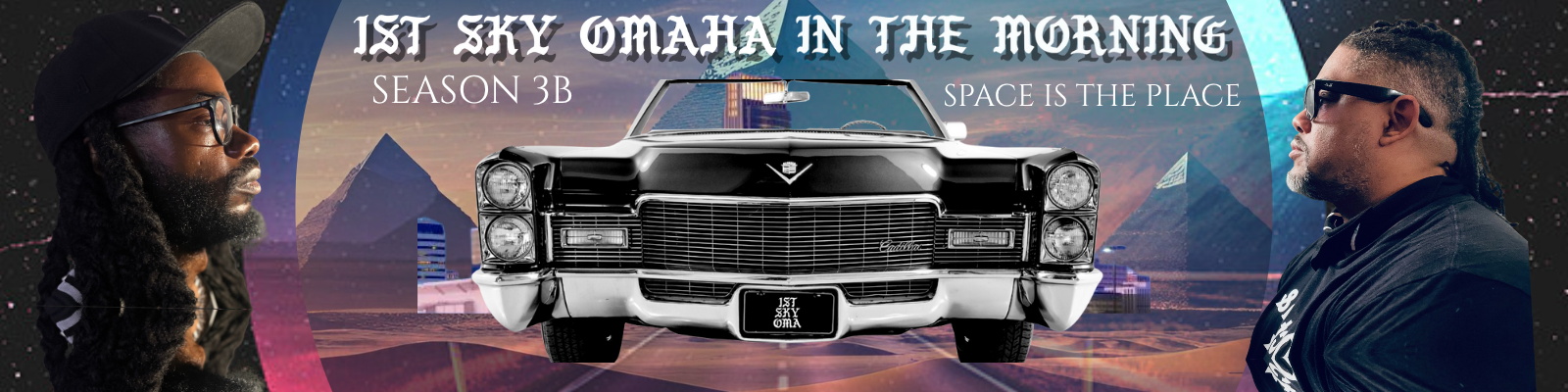
It was a Love Supreme Friday on 1st Sky Omaha in the Morning, and hosts Paul B. and Buddy the God brought the kind of energy that makes you want to pull up a chair, pour a cup of coffee, and lean in. Season 4, Episode 53 was equal parts civic reflection, community celebration, and visionary conversation — with a guest whose work just might reshape the future of North Omaha one young musician at a time.
The show opened with a look back at Nebraska’s recent primary election results, and both hosts were candid about what the numbers mean for the community. Buddy the God set the tone early, reminding listeners that political engagement isn’t optional: “None of this really matters if everybody voted. We got to do both — build our own ecosystems and continue to figure out the political structure, because whether you want to be engaged in it or not, you’re a part of it. Don’t pay taxes and see what happens.” Viewer Kimber Snipes offered a thoughtful counterpoint in the chat, noting, “I’ve been having conversations with people between the ages of 20 and 35. What I hear the most is most of them don’t really know what to do and know nothing about the candidates. I don’t think we should be slamming people for not voting when the system is really what has caused this. I think we need to have more education and deep dive discussions.” It was exactly the kind of honest, layered dialogue the show does best.
Before diving into the main interview, the hosts paused to celebrate some significant community wins. Core Science Bio Diagnostics took home a $52,000 prize. Omaha North’s engineering program earned national recognition. And the Heart Ministry Center announced plans for an upcoming grocery store — a development that drew real excitement. These weren’t passing mentions; they were framed as proof of something the show returns to again and again: the idea that North Omaha is not waiting to be saved. It’s already moving. Buddy the God calls it “building ecosystems within ecosystems,” and this week’s guest is living proof of exactly that.
Dana Murray, founder and director of the North Omaha Music Academy (NMA), joined the show for a conversation that felt less like an interview and more like a master class. Murray, a South Omaha native who spent eleven years in New York City before returning home, has been teaching music in Omaha for two decades. He runs NMA out of a space on North 24th Street — what Paul B. has long called “the most important black corner in Nebraska” — and his vision for what that corridor can become is both practical and profound.
Murray didn’t sugarcoat the challenges. Asked about the state of the North 24th Street corridor, he was direct: “We’ve been so far removed from what the rest of Omaha views North 24th Street as. I’m more talking to the people that are there who are so far removed from what that was that it is hard to build momentum from within when a lot of the community can’t relate to the power of what was.” And yet his blueprint for revival is remarkably concrete. “You have to have enough housing, enough people from within to fuel the area, places of service, parking, laundromats, groceries, gas stations — all the things that any area needs to be self-sustained,” he said. “And then you have to have destinations — entertainment, restaurants, lounges, things that are going to be your bread-and-butter attractions. It would be great to have a hotel. With a hotel, now you can throw larger attractions, music festivals, conferences right in the community.”
Viewer Pops chimed in from the chat with a note that brought that history into sharp focus: “Artists like Fats Domino used to stay at your grandfather’s home when he came to town to perform. So yes, more infrastructure for the artist around the Deuce corridor would be a godsend.” It was one of those moments that reminded everyone watching just how rich — and how real — that legacy truly is.
But Murray’s work at NMA goes well beyond instrument lessons. The academy teaches live sound engineering, broadcasting, podcasting, and even conducts artist interviews — with the students behind the microphone. “It’s not just telling them ‘oh, you can be this,'” Murray said. “No, you can be this right now. Once you remove those barriers, the sky’s the limit.” Paul B. connected this directly to what he calls the “secondary matrix” — the deeper purpose beneath the surface work. “In Dana Murray’s case, he teaches kids music — but the secondary matrix is to create critical thinkers,” Paul B. explained. Viewer Pops echoed that idea beautifully: “I experienced my secondary matrix in junior high when I took algebra. I was gaining proficiency and noticed I was suddenly able to think outside the box on several different levels. Music the same.”
Looking ahead, Murray outlined an ambitious capital campaign — with a first phase goal of $20 million — aimed at building a full NMA campus. His model? Omaha Performing Arts, which generates an estimated $40 to $50 million in annual revenue for the downtown corridor. “That’s what we’re working toward for North Omaha,” he said. And on the broader question of culture and economics, Murray was unequivocal: “The sooner we understand that our culture is equity, that our brilliance and our artistic genius is equity, the better off we’re going to be. Every music in America has been built off of our experience — you trace it all the way back to the music that was brought over here from Africa. And that’s equity.”
The show also previewed the upcoming NMA Fest, and Murray encouraged music educators interested in joining the academy’s growing team to reach out directly at dmurray@northomahamusic.org or contact his assistant Andrew Bailey at abailey@northomahamusic.org.
As the episode wrapped, viewer Senator KML said it simply and sincerely in the chat: “Thank you, Uncle Dana. You’re changing lives in big ways. We are the students.” On a Love Supreme Friday, that felt like exactly the right note to end on.
If you missed it, catch the full episode on the 1st Sky Omaha in the Morning replay — and make sure you’re tuned in Monday morning. The conversation is just getting started.