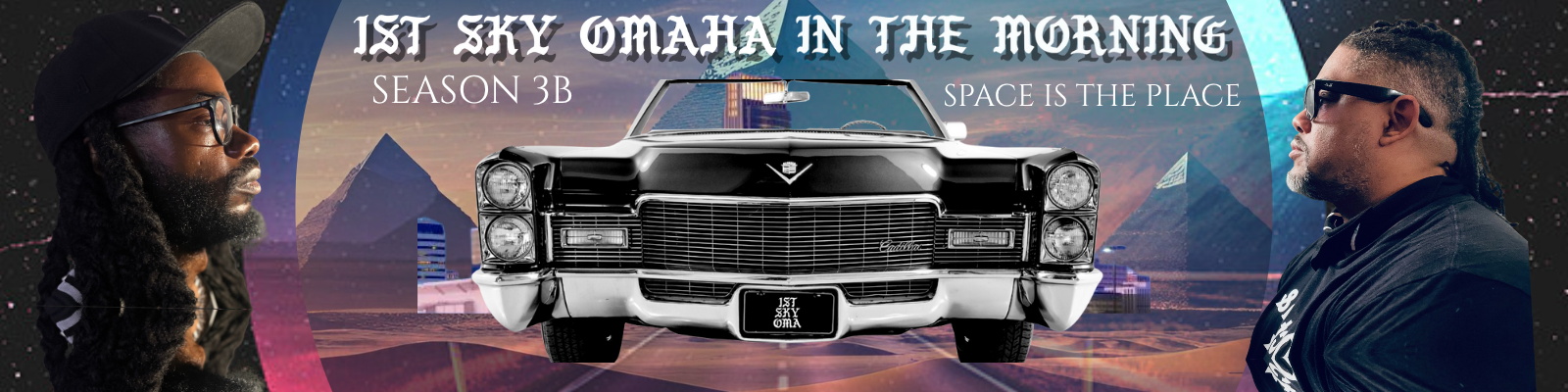
It was a Love Supreme Friday on 1st Sky Omaha in the Morning, and hosts Paul B. and Buddy the God brought the kind of energy that makes you want to pull up a chair, pour a cup of coffee, and lean in. From election results to music education to the future of North 24th Street, the conversation moved like a good jazz set — purposeful, layered, and full of heart.
The show opened with a candid look at Nebraska’s primary turnout, and the numbers were sobering. Buddy the God read aloud a post from Raquel Henderson of the mayor’s office that stopped the room: “Only 339,000 out of more than 1.2 million registered voters in Nebraska showed up yesterday. Think about that for a second. And yet everybody has something to say. Posting on Facebook is not enough. Awareness without action changes nothing.” Viewer Kimber Snipes offered a thoughtful counterpoint in the chat, writing that her conversations with people between the ages of 20 and 35 revealed that most of them simply don’t know what to do or who the candidates are. “I don’t think we should be slamming people for not voting when the system is really what has caused this,” she wrote. “I think we need to have more education and deep dive discussions.” Buddy the God echoed a both/and approach: “We got to do both. We got to do both in the now. We have to build our own ecosystems and continue to do the things that are about to talk about, but in the long run, we do got to figure this out as far as a nation.”
That idea of building ecosystems — communities within communities, purpose beneath purpose — became the throughline of the entire show. Paul B. introduced what he called the “secondary matrix,” a concept that grew out of a personal experience on a film set. “We decided we were going to build a lemonade stand that could last and then the kids could use it after we were done,” he recalled. “That’s when this whole idea of the secondary matrix came to me.” The deeper meaning, he explained, is that the most impactful work always has a second layer of purpose running beneath it.
Nowhere was that more evident than in the morning’s featured guest: Dana Murray, director of the North Omaha Music Academy (NMA), located on the corner of 24th and Lake. Formerly known as Love’s Jazz, NMA is a youth music academy, performance space, and — if Dana Murray has his way — the future anchor of a thriving cultural and arts district stretching along the North 24th Street corridor.
Murray grew up in South Omaha, spent eleven years building his craft in New York City, and came back to Omaha with a vision. Some questioned whether someone from South Omaha had a place leading an institution rooted in North Omaha’s legacy. His answer was both honest and disarming. “If you’re black and you’re in Omaha, especially in the 70s and early 80s, North Omaha was the Mecca for us,” he said. “Everyone had a shared relationship with North Omaha.” He went further, taking on what he called a missed opportunity: “I love Native Omaha Days at its core — anything that can bring us together — but it’s a failed opportunity to showcase our culture because none of that is trying to invite the rest of Omaha down to partake in what we have to offer.” His approach at NMA has been exactly the opposite. “People told me that was going to be very hard,” he said, “but people have no problem coming from wherever they are in Omaha or Iowa to come down North 24th Street to hear jazz music.”
Murray’s vision for the corridor is ambitious, detailed, and rooted in practicality. He described what a true cultural district requires — housing, parking, laundromats, grocery stores, gas stations — the full infrastructure of a self-sustaining neighborhood — alongside destination attractions like restaurants, entertainment venues, and ideally, a hotel. “With a hotel, now you can throw larger attractions, music festivals, conferences right in the community,” he said. He pointed to Omaha Performing Arts as a model, noting that it generates $40 to $50 million in annual revenue for downtown. “That’s what we’re working toward for North Omaha,” he said. “I see NMA taking up that space.” The first phase of NMA’s capital campaign is set at $20 million, aimed at building a full campus on the corridor.
But the work at NMA isn’t waiting for a capital campaign to change lives. Murray described a curriculum that goes well beyond instrument instruction. Students learn live sound engineering, podcast production, and broadcast — including how to conduct interviews with visiting artists. “So it’s not just telling them, ‘Oh, you can be this.’ No — you can be this right now,” he said. When Paul B. noted that teaching kids music rewires the brain — “your brain synapsis starts firing in different ways” — Murray built on that idea with quiet conviction. “We’re not only raising musicians but, more importantly, raising more critical thinking human beings. Whatever they choose to do, they’re going to be better because they were aligned with artistry.”
On the challenge of holding students’ attention in an era of YouTube, ChatGPT, and viral content, Murray was refreshingly direct. “We are in crisis with education,” he said, “not just young black kids, young kids in general — because we are losing the ability to inspire them.” His philosophy is to meet young people where they are rather than force an outdated curriculum on them. “The why they’re doing it is everything — they don’t need us for the what. They can go to YouTube and see anything we’re trying to teach them. So the instructors we bring in have to have in their arsenal the ability to inspire another human being.”
The conversation wrapped with a powerful reflection on culture as currency. “The sooner we understand that our culture is equity, that our brilliance and our artistic genius is equity, the better off we’re going to be,” Murray said. “Every music in America has been built off of our experience. From the hardest rock music to the jazziest jazz music to the poppiest of pop music, you trace it all the way back to the music that was brought over here from Africa. And that’s equity.” Viewer Pops felt it deeply, writing in the chat: “I love this interview. This brother’s vibe is so cool and his intentions are admirable. First Sky loves the kids.”
The show also made space for joy. Viewer Aeros 402 shared a beautiful moment mid-broadcast: “On a love note, my only daughter gave birth to my second granddaughter. They are both new and good. I feel blessed.” The whole chat, it seemed, paused to celebrate.
Music instructors interested in joining the NMA team can reach Dana Murray at dmurray@northomahusic.org or his assistant Andrew Bailey at abailey@northomahusic.org. The upcoming four-night NMA Fest is on the horizon — details to follow through NMA’s channels.
It was the kind of Friday morning that leaves you feeling like the community is building something real. Paul B. said it plainly: “I’ve always called it the most important black corner in Nebraska. We got to serve it. We have to be of service to it.” If this morning’s conversation was any indication, that service is well underway.
Join Paul B., Buddy the God, and the whole 1st Sky Omaha family Monday morning — you never know who’s coming through, but you can count on the conversation being worth your time.