

Read the full article on KETV 7

A new generation of tractors powered by methane is coming Nebraska, offering a potential path toward more sustainable farming while reducing reliance on increasingly expensive diesel fuel.CNH Industrial recently donated two methane-powered tractors to the University of Nebraska-Lincoln, where students and researchers will study how the machines compare with traditional diesel-powered equipment.“We are taking the research and the concepts and turning them into action,” said Dr. Derek McLean, dean and director of the university’s Agricultural Research Division.The tractors are now part of the curriculum at UNL’s Eastern Nebraska Research, Extension and Education Center, where students will gain hands-on experience with the emerging technology.“These students are going to be the key aspect in driving this technology,” said Andy Dozler, an engineering manager at CNH’s Grand Island plant.The mandate of innovation at CNH was greater self-sufficiency.“There was a big push to come up with an alternative fuel source, so there’s a lot of electrification” said Joshua Richardson, a field after-sales manager for CNH’s New Holland brand. “The problem with electrification on tractors is how big of a battery do you want to tow behind it.”Instead, CNH has turned to compressed natural gas, allowing tractors to run on methane that can be captured from livestock operations or landfills. The approach could enable farmers to produce their own fuel while significantly cutting emissions.In parts of Europe, similar systems are already in use.“A lot of the dairies already have digesters,” Richardson said. “They’re running their entire operation off the methane gas they’re producing.”The technology is gaining attention as lingering conflict in Iran has sent the price of diesel soaring.“It is much cheaper in terms of price today,” said Joe Luck, interim head of UNL’s Department of Biological Systems Engineering.Researchers at the university plan to evaluate the tractors’ efficiency, cost savings and efficiency under real-world conditions and share those findings statewide through Nebraska Extension programs.“We can try these things out in our real-world operation, see how they’re going to perform,” Luck said.The two tractors are among just three methane-powered models currently in Nebraska. The third is being used at Lincoln Airport to help maintain grounds.
A new generation of tractors powered by methane is coming Nebraska, offering a potential path toward more sustainable farming while reducing reliance on increasingly expensive diesel fuel.
Advertisement
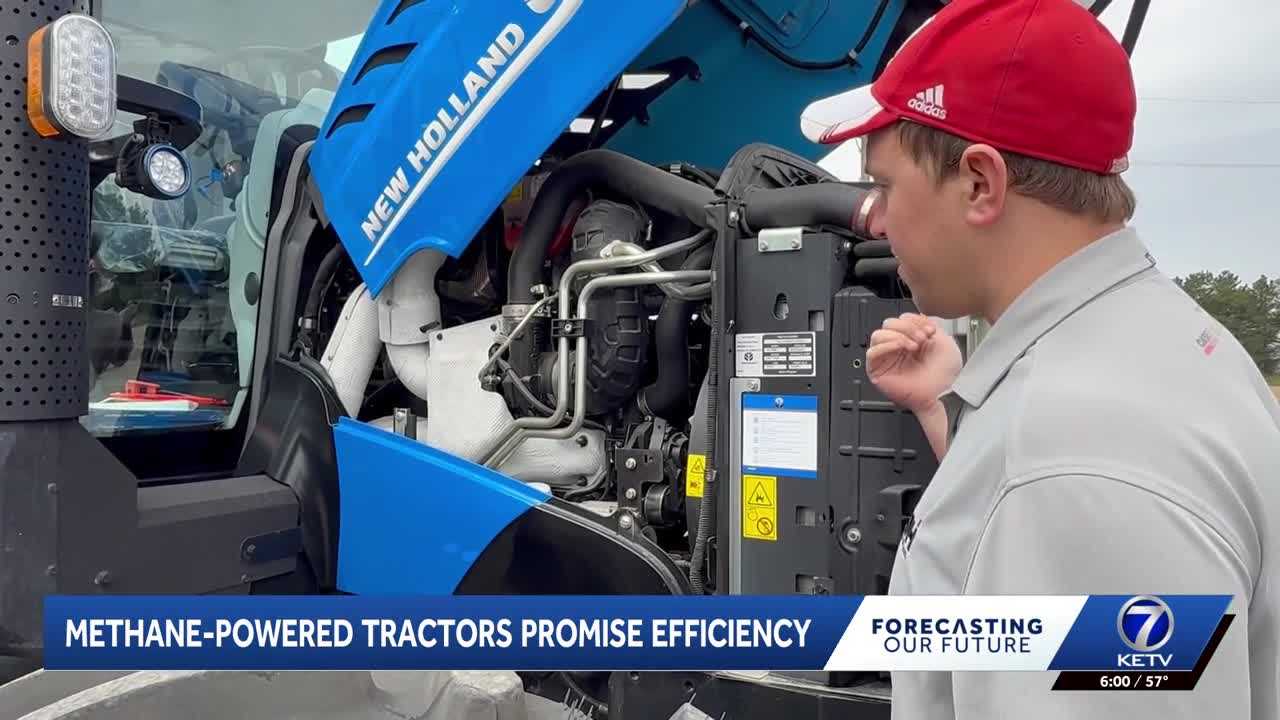
CNH Industrial recently donated two methane-powered tractors to the University of Nebraska-Lincoln, where students and researchers will study how the machines compare with traditional diesel-powered equipment.
“We are taking the research and the concepts and turning them into action,” said Dr. Derek McLean, dean and director of the university’s Agricultural Research Division.
The tractors are now part of the curriculum at UNL’s Eastern Nebraska Research, Extension and Education Center, where students will gain hands-on experience with the emerging technology.
“These students are going to be the key aspect in driving this technology,” said Andy Dozler, an engineering manager at CNH’s Grand Island plant.
The mandate of innovation at CNH was greater self-sufficiency.
“There was a big push to come up with an alternative fuel source, so there’s a lot of electrification” said Joshua Richardson, a field after-sales manager for CNH’s New Holland brand. “The problem with electrification on tractors is how big of a battery do you want to tow behind it.”
Instead, CNH has turned to compressed natural gas, allowing tractors to run on methane that can be captured from livestock operations or landfills. The approach could enable farmers to produce their own fuel while significantly cutting emissions.
In parts of Europe, similar systems are already in use.
“A lot of the dairies already have digesters,” Richardson said. “They’re running their entire operation off the methane gas they’re producing.”
The technology is gaining attention as lingering conflict in Iran has sent the price of diesel soaring.
“It is much cheaper in terms of price today,” said Joe Luck, interim head of UNL’s Department of Biological Systems Engineering.
Researchers at the university plan to evaluate the tractors’ efficiency, cost savings and efficiency under real-world conditions and share those findings statewide through Nebraska Extension programs.
“We can try these things out in our real-world operation, see how they’re going to perform,” Luck said.
The two tractors are among just three methane-powered models currently in Nebraska. The third is being used at Lincoln Airport to help maintain grounds.