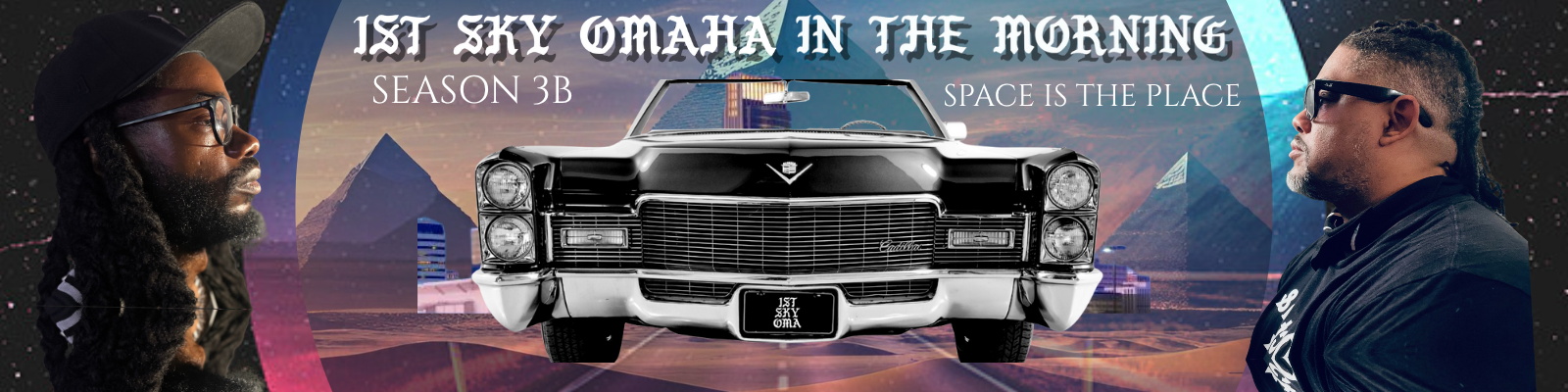
It was a Love Supreme Friday on 1st Sky Omaha in the Morning, and hosts Paul B. and Buddy the God were determined to keep the energy exactly where the name promised — elevated, purposeful, and rooted in community. “We have to make a decision,” Paul B. told viewers at the top of the show. “It’s going to be Love Supreme Friday today. And we’re going to change our mindsets over to something else — because it’s real easy to let your emotions take over when there’s so much to be emotional about.” With that spirit firmly in place, the show settled into one of its most substantive conversations of the season.
The featured guest was Dana Murray, founder and director of the North Omaha Music Academy — known to many longtime locals as Love’s Jazz — anchored on North 24th Street. A musician and educator with twenty years of teaching experience in Omaha, Murray spent eleven years in New York City before returning home with a vision that extends far beyond music lessons. What he’s building, he made clear, is nothing short of a cultural and economic engine for North Omaha.
The conversation opened on a question that Paul B. returns to often: what should the North 24th Street corridor actually become? Murray didn’t hesitate. “There are metrics for the success of any district,” he said. “You have to have enough housing, places of service, parking, laundromats, groceries, gas stations — all the things any area needs to be self-sustained. As a district, you need destinations: entertainment, restaurants, lounges, things that are your bread-and-butter attractions to draw people in.” He went further, floating the idea of a hotel in the corridor — one that could support large-scale music festivals and conferences happening right in the community. “There’s been a whole lot of stuff on North 24th Street that wasn’t sustainable,” he added. “I can’t get caught up in the emotion of the redevelopment. The X’s and O’s have to make sense.”
It was a grounded, pragmatic perspective — and one that resonated deeply with viewers. Viewer Pops chimed in from the chat: “Artists like Fats Domino used to stay at your grandfather’s home when he came to town to perform. So yes, more infrastructure for the artist around the Deuce corridor would be a godsend.” Paul B. has long held that North 24th Street carries a weight unlike anywhere else in the state. “I’ve always called it the most important black corner in Nebraska,” he said. “We have some history there, some legacy there — and we have to be of service to it.”
Murray, who grew up in South Omaha, addressed the question of his place in a North Omaha ecosystem with characteristic candor. “If you were black and in Omaha, especially in the ’70s and early ’80s, everyone had a shared relationship with North Omaha,” he said. “That was the Mecca for us.” He pushed back gently but firmly on the insularity he believes has cost the corridor opportunities. “At every opportunity, we fail at taking advantage of showcasing our culture and highlighting the excellence of who we are,” he said, pointing to Native Omaha Days as a beloved tradition that nonetheless hasn’t fully opened its arms to the broader city. “One of the things I’ve tried to do was reach out and be a beacon for all of Omaha to come down to North 24th Street. People told me that was going to be very hard. And people don’t have any problem coming from wherever they are in Omaha or Iowa to come hear jazz music.”
As for what NMA is building, Murray drew a striking comparison. “If you think of Omaha Performing Arts and what it means to downtown — not only as a cultural and entertainment entity but as an economic vehicle bringing in $40 to $50 million in revenue every year — that’s what we’re trying to build for North Omaha.” But the academy’s mission runs deeper than performance. Students learn live sound engineering, broadcast production, podcasting, and interviewing. They learn who Buddy Miles was. They learn why Victor Lewis is one of the most recorded jazz drummers in history. “It’s not just telling them they can be something,” Murray said. “It’s showing them they can be it right now.”
“We’re not only raising musicians; more importantly, we’re raising more critical-thinking human beings. Whatever these kids choose to do, they’re going to be better because they were aligned with artistry.”
Buddy the God drew a personal connection, reflecting on his own time in Omaha North’s engineering program. “Just like what brother Dana Murray said about his music students, I myself didn’t necessarily go into the field of civic engineering, but that critical thinking — that understanding of processes and systems — is still within me.”
The bigger vision, Murray shared, involves a full NMA campus anchored by a $20 million first phase of a capital campaign. “I see NMA taking up that space,” he said. “The larger the attractions, the larger the crowds, the more fuel you have to develop an area. Money is not our issue in North Omaha. It’s transformative ideas that are going to allow us to be not only sustainable but gainfully active.” Underlying all of it is a philosophy Murray articulated with quiet force: “Our culture is equity. Our brilliance and our artistic genius is equity. Every music in America has been built off of our experience — and that’s equity for us to build and monetize for our community.”
Viewer Senator KML put it simply from the chat: “Thank you, Uncle Dana. You’re changing lives in big ways. We are the students.”
The show also touched on Nebraska’s midterm primary results and the persistent challenge of civic engagement in North Omaha. Buddy the God was direct: “None of this really matters if the people don’t vote. And that’s a pretty valid point — a lot of this doesn’t matter if everybody voted.” Viewer Kimber Snipes offered a nuanced counter from the chat: “I’ve been having conversations with people between the ages of 20 and 35. What I hear most is that they don’t really know what to do and know nothing about the candidates. I don’t think we should be slamming people for not voting when the system is really what has caused this. I think we need more education and deep dive discussions.” It was the kind of exchange that makes the 1st Sky community feel less like an audience and more like a conversation.
Paul B. tied the morning’s themes together with his concept of the “secondary matrix” — the idea that behind every surface-level exchange lies a deeper community purpose. “The primary matrix is us on this show — talking heads talking about the news,” he said. “The secondary matrix is when we build community, build coalition, and speak to a family of people so we can get to some action.” On a Friday morning filled with music, history, vision, and a new granddaughter (congratulations to viewer Aeros 402 and family!), it felt like exactly that.
If you’d like to connect with the North Omaha Music Academy — whether as a student family, a prospective instructor, or a community partner — Dana Murray can be reached at dmurray@northomahahusic.org, and his assistant Andrew Bailey at abailey@northomahahusic.org. And don’t forget: NMA Fest is on the horizon, and North 24th Street is calling.
Tune in Monday morning for another hour of news, community, and conversation right here on 1st Sky Omaha in the Morning — because in this city, the best conversations happen before noon.