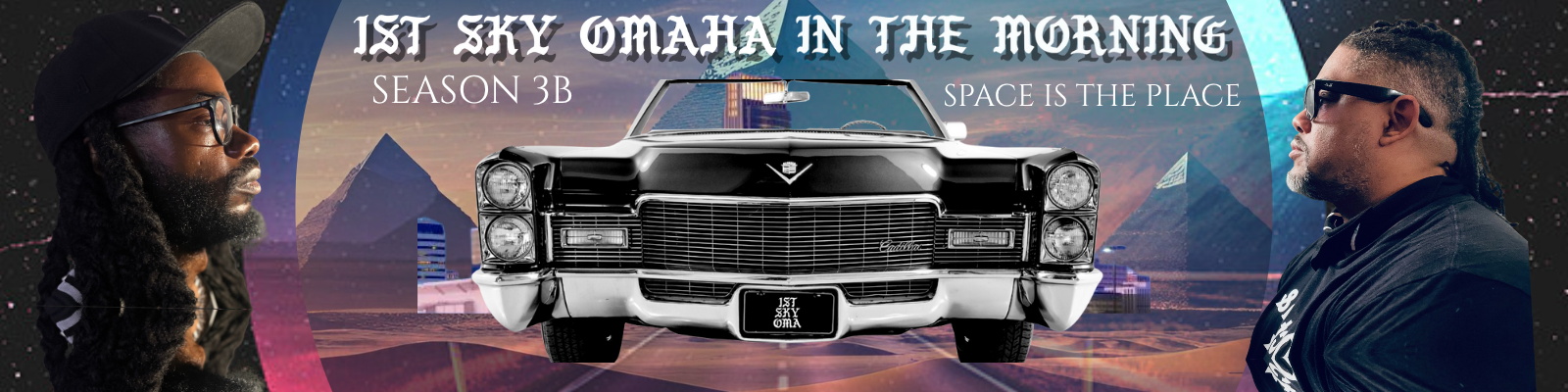
It was a “Love Supreme Friday” on 1st Sky Omaha in the Morning, and hosts Paul B. and Buddy the God set the tone early — easy, community-minded, and forward-looking. After weeks of heavy political coverage surrounding Nebraska’s primary elections, Paul B. made clear the show was ready to exhale. “We’ve been talking a lot of politics for a while and — we got a little break after the primaries,” he said. “Never going to go away completely, but it doesn’t have to dominate the show today.”
And dominate it did not. Instead, the morning unfolded like a conversation you’d want to be part of — full of music, ambition, community pride, and a guest who reminded everyone why North 24th Street still matters.
That guest was Dana Murray, executive director and founder of the North Omaha Music Academy (NMA), the organization formerly known as Love’s Jazz. A South Omaha native who spent eleven years in New York City before returning home, Murray has planted himself firmly on the North 24th Street corridor with a mission that reaches far beyond music lessons.
“Really, the area that has the most history and can claim to be a cultural and arts district — for real — is the North 24th Street corridor,” Murray told the hosts. “But we’ve been so far removed from that. A lot of the community within can’t relate to the power of what was.” He laid out a vision for what the corridor could become: enough housing, places of service, eateries, parking, and — critically — destinations. “It would be great to have a hotel,” he said, “because then you can throw larger attractions, music festivals, and conferences right in the community.”
Paul B., who has long championed the stretch known as “the Deuce,” didn’t hold back his own conviction. “When I’ve always called it the most important Black corner in Nebraska — we got to serve it,” he said. “We have to be of service to it.” Viewer Pops added a personal footnote to that history, writing in chat: “Artists like Fats Domino used to stay at your grandfather’s home when he came to town to perform. So yes, more infrastructure for the artist around the Deuce corridor would be a godsend.”
Murray was candid about what he sees as a persistent missed opportunity. “One of the things that holds us back is a false sense of security with pride as it pertains to North Omaha,” he said. “At every opportunity, we fail at taking advantage of showcasing our culture.” He pointed to Native Omaha Days as a beloved but underutilized platform. “I love it at its core, but it’s a failed opportunity to showcase our culture because none of it is trying to invite the rest of Omaha down to partake in what we have to offer.” His own experience, he said, has proven the skeptics wrong. “People have no problem coming from wherever they are in Omaha or Iowa to hear jazz music. That taboo about the area and its ability to be an attraction was false — we’ve proven that.”
When it comes to NMA itself, Murray thinks big — deliberately so. He pointed to Omaha Performing Arts as a model: not just a cultural institution, but an economic engine generating $40 to $50 million in annual revenue for its surrounding area. “We need a vehicle like that for North Omaha, and I see NMA taking up that space,” he said. The academy’s first capital campaign phase is set at $20 million, with an eventual NMA campus as the goal.
But the mission isn’t just bricks and mortar. It’s about the young people inside those walls. “Not all these young kids are going to become musicians — some will become doctors, lawyers, business owners,” Murray said. “But whatever they choose to do, they’re going to be better because they were aligned with artistry.” He was equally direct about what makes a great instructor: technical skill matters, but inspiration matters more. “Unless you’re able to inspire a young person, they don’t really have the attention span for the X’s and O’s of music. The why they’re doing it is everything.” Viewer Senator KML said it simply in the chat: “Thank you, Uncle Dana. You’re changing lives in big ways. We are the students.”
NMA is currently seeking music instructors. Interested educators can reach Dana Murray at dmurray@northomahusic.org or assistant Andrew Bailey at abailey@northomahusic.org.
The show also celebrated some community wins. Charell Shelton earned a $52,000 diagnostic lab prize — a moment the hosts made sure to mark with enthusiasm. And on the civic front, Paul B. read from a post by Raquel Henderson of the mayor’s office that stopped the conversation cold: “Awareness without action changes nothing. Posting on Facebook is not enough.” Primary voter turnout was a sobering topic, with viewer Sean McCarthy noting that the Douglas County Election Commissioner reported average turnout of around 35 percent. Viewer Kimber Snipes offered some context: “What I hear the most is most of them don’t really know what to do and know nothing about the candidates. Politics also seems — because it is — very messy to them.”
The show closed on a reflective note with a discussion of what Buddy the God called the “secondary matrix” — the idea that everything the show does carries a deeper purpose beneath the surface. Paul B. put it plainly: “On the surface we’re a couple of talking heads — but what we’re really trying to do is build community, build some coalition, build a family of people that we can regularly talk to and come to some conclusions and get to some action.” Buddy expanded the idea outward: “An ecosystem that lives on and perpetuates itself — not just building a system that works in tandem as far as 24th Street, but that looks forward and builds the next generation.” Even viewer Pops connected it to his own life: “I experienced my secondary matrix in junior high when I took algebra. I was gaining proficiency and noticed that I was suddenly able to think outside the box on several different levels. Music the same.”
It was the kind of Friday morning that leaves you a little more hopeful than when you woke up. Tune in Monday — the conversation is just getting started.