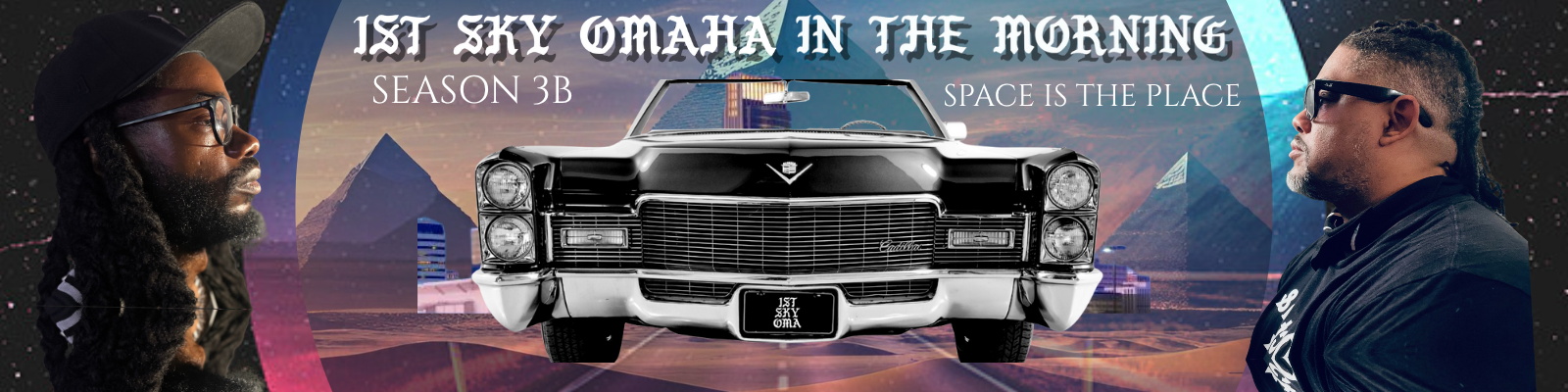
It was a Love Supreme Friday on 1st Sky Omaha in the Morning, and hosts Paul B. and Buddy the God were ready to shift the energy. After weeks of primary election coverage, the show made a deliberate turn toward something more nourishing. “We’ve been talking a lot of politics for a while and we got a little break after the primaries,” Paul B. told the audience. “It’s going to be Love Supreme Friday today, and we’re going to change our mindsets over to something else.” But before the pivot was complete, the conversation briefly touched on the sobering reality of Tuesday’s results — only 339,032 of Nebraska’s more than 1.2 million registered voters showed up to cast a ballot. Viewer Raquel Henderson put it plainly in the chat: “Think about that for a second. And yet everybody has something to say. Posting on Facebook is not enough. Awareness without action changes nothing.” Buddy the God echoed that sentiment on air: “None of that really matters if the people don’t vote — and even the gerrymandered racist maps are still based on who’s registered, who’s of age, and actually who comes out to vote.”
With that civic moment acknowledged, the show turned its full attention to the kind of community-building that happens outside of election cycles — the steady, unglamorous, transformative work of building something that lasts. That’s where Dana Murray came in.
Murray is the founder of the North Omaha Music Academy (NMA), formerly known as Love’s Jazz, situated on the historic North 24th Street corridor. A musician and educator who grew up in South Omaha, spent eleven years sharpening his craft in New York City, and then came home to Omaha to invest in its youth, Murray brought a rare combination of street-level credibility and big-picture vision to the conversation.
Paul B. set the table by invoking the cultural weight of the corridor itself. “I’ve always called it the most important black corner in Nebraska,” he said. “We have some history there and some legacy there, and that’s what it’s about.” Viewer Pops reinforced that history from the chat: “Artists like Fats Domino used to stay at your grandfather’s home when he came to town to perform. More infrastructure for the artist around the Deuce corridor would be a godsend.”
Murray agreed — and he wasn’t short on specifics. His vision for North 24th Street is nothing less than a fully functioning cultural and arts district, built on real economic infrastructure. “As a district, there are metrics for success,” he explained. “You have to have enough housing, places of service, parking, laundromats, groceries, gas stations — all the things any area needs to be self-sustained. You also have to have destinations: entertainment, restaurants, lounges. It would be great to have a hotel. With a hotel, now you can throw larger attractions, music festivals, conferences right in the community.” He was equally candid about what hasn’t worked. “There’s been a whole lot of stuff on North 24th Street that wasn’t sustainable, and I can’t get caught up in the emotion of the redevelopment — the X’s and O’s have to make sense.”
Murray also challenged what he called a “false sense of security with pride” that sometimes keeps the community from fully showcasing itself to the broader city. He pointed to South Omaha’s Cinco de Mayo celebration as a model of inclusive cultural pride — one that invites all of Omaha in rather than keeping the celebration contained. “I’ve tried to reach out and be a beacon for all of Omaha to come down to North 24th Street,” he said, “and people have no problem coming from wherever they are in Omaha or Iowa to come hear jazz music. That taboo about the area and its ability to be an attraction was false. We’ve proven that.” Viewer Mark Manor backed him up from the chat: “When I go there it is the same people at shows at Waiting Room, Slow Down, and the Jewels. So people are coming from all around town and getting down at NMA, which I find impressive.”
At the heart of NMA is a youth music academy — but Paul B. was quick to identify what he called the “secondary matrix” at work. “There’s always a deeper meaning to what it is that you’re talking about doing,” Paul B. said. “In Dana Murray’s case, he teaches kids music, but really he’s creating critical thinkers.” Murray confirmed it without hesitation. “All these young kids are not going to become musicians by choice,” he said. “Some will become doctors, some lawyers, some business owners. Whatever they choose to do, they’re going to be better because they were aligned with artistry.” NMA also runs a broadcast lab where students learn live sound, streaming, and podcasting — and conduct their own artist interviews. “It’s not just telling them they can be something,” Murray said. “It’s having them be it right now.”
The ambition doesn’t stop there. Murray described a planned $20 million capital campaign — the first phase of what he envisions as a full NMA campus modeled after the economic impact of Omaha Performing Arts downtown. “We need a vehicle like that for North Omaha, and I see NMA taking up that space,” he said. But the deeper point was philosophical. “Our culture is equity. Our brilliance, our artistic genius is equity. The sooner we look at it not as a cool little music thing but as equity for us to build and monetize for our community, the better we’re going to be.”
NMA is also actively seeking qualified music instructors who can do more than just teach scales. “Anyone can have the X’s and O’s of teaching,” Murray said, “but unless you’re able to inspire a young person, they don’t really have the attention span for the X’s and O’s of music.” Educators interested in joining the team can reach Murray at dmurray@northomahahusic.org or his assistant Andrew Bailey at abailey@northomahahusic.org. NMA Fest is also on the horizon — details are forthcoming, so keep an eye on the academy’s channels.
As the show wound down, Buddy the God left the audience with a message as simple as it was powerful: “All you have to do is find get in where you fit in. The lanes are running. The lanes are wide open. Just get in where you fit in and make it happen.” Viewer Pops closed out the chat the way only a Friday regular can: “Thanks for another great week of shows. You and the Chat Chimers have made First Sky a true pillar in the community. Have a great weekend, and I’ll see you on Monday.”
Hard to say it better than that. Tune in Monday morning and bring a neighbor — there’s always room in the conversation.