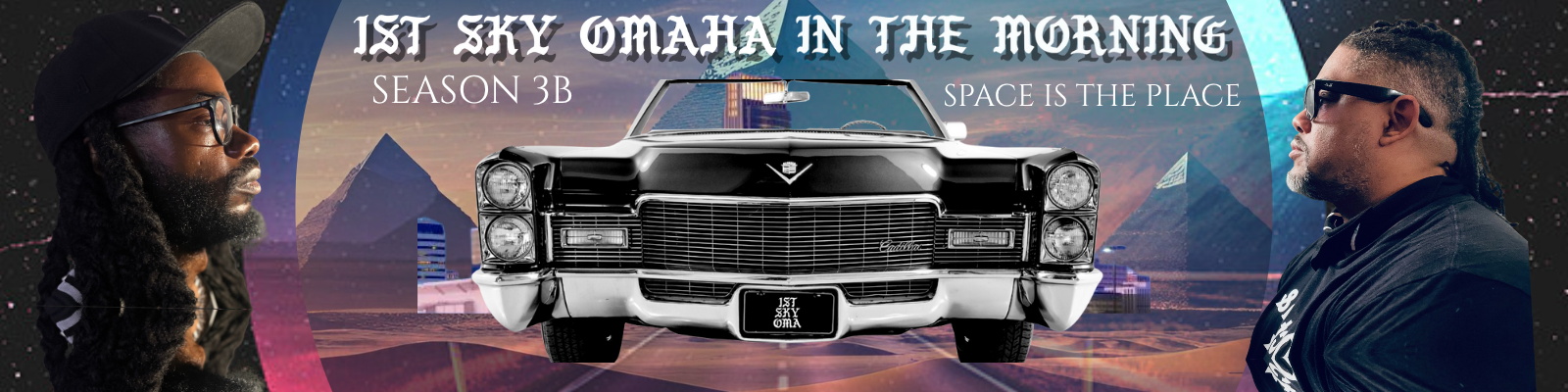
There’s something quietly powerful about a Friday morning show that makes a deliberate choice to step back from the noise and lean into hope. That’s exactly what hosts Paul B. and Buddy the God did on this week’s Love Supreme Friday edition of 1st Sky Omaha in the Morning — and the result was one of the most energizing, community-rooted conversations the show has delivered in recent memory.
“We’ve been talking a lot of politics for a while and it’s time to make a decision — it’s going to be Love Supreme Friday today,” Paul B. told viewers at the top of the show. “We’re going to change our mindsets over to something else.” That something else turned out to be music, vision, young people, and the future of one of Omaha’s most storied stretches of street.
The shift in tone didn’t mean stepping away from substance. Buddy the God offered a pointed reflection on what’s been lost since the era of integration — and what communities like North Omaha are still working to reclaim. “We lost something with integration,” he said. “Understanding what it is that we lost and how to get that back — it really is this ecosystem within the ecosystem.” It’s the kind of observation that sounds simple on the surface but lands with weight when you think about it long enough.
Viewer Pops chimed in from the chat with a piece of personal history that underscored the point beautifully: “Artists like Fats Domino used to stay at your grandfather’s home when he came to town to perform. So yes, more infrastructure for the artist around the Deuce corridor would be a godsend.” It was a reminder that North 24th Street — “the Deuce,” as regulars call it — didn’t just happen to be a cultural hub. It was built that way, by people, over generations.
The guest at the center of Friday’s conversation was Dana Murray, founder and director of the North Omaha Music Academy (NMA), formerly known as Love’s Jazz, located right on North 24th Street. Murray — a musician who spent eleven years in New York City before returning home to Omaha — has a vision for North 24th that is equal parts practical and inspiring.
“The area that has the most history and the one that can claim we are a cultural and arts district, for real, is the North 24th Street corridor,” Murray said. But he was candid about the challenge: the community has drifted from its own legacy. “It is hard to build momentum from within,” he acknowledged, adding that a truly thriving district needs housing, services, destinations — restaurants, lounges, and ideally even a hotel that could anchor larger music festivals and conferences right in the neighborhood.
Murray was equally direct about a missed opportunity he sees in how the community currently celebrates itself. He spoke warmly of Native Omaha Days at its core, but noted it functions more like an internal family reunion than a cultural showcase. “All we have to do is look at South Omaha’s Cinco de Mayo and how they champion their culture,” he said. “They invite everybody down to be part of it.” Murray said he’s tried to model that inclusive approach with NMA — and the results have spoken for themselves. “People don’t have any problem coming from wherever they are in Omaha or Iowa to come down to North 24th Street to hear jazz music.”
Paul B. put a fine point on NMA’s deeper purpose through what he calls the “secondary matrix” — the idea that everything meaningful has a layer beneath its surface. “In Dana Murray’s case, he teaches kids music,” Paul B. explained, “but the secondary matrix is to create critical thinkers.” Murray confirmed exactly that vision. “We’re not only raising musicians but more importantly raising more critical-thinking human beings,” he said. “These young kids are not all going to become musicians — some will become doctors, lawyers, business owners — but whatever they choose to do, they’re going to be better because they were aligned with artistry.”
NMA’s programming goes well beyond instruments. Students also learn live sound engineering, broadcasting, podcasting, and how to interview working artists. Murray described a broadcast lab where students aren’t just told they could have careers in media someday — they’re doing it now. “Once you remove those barriers, the sky is the limit,” he said simply.
Looking ahead, Murray is launching a capital campaign — with a first phase goal of $20 million — aimed at building a full NMA campus that could serve North Omaha the way Omaha Performing Arts serves downtown. “Money is not our real issue in North Omaha,” he said. “It’s transformative ideas.” He pointed to Black musical culture as an underutilized asset. “Every music in America has been built off of our experience — from the hardest rock music to the jazziest jazz. That’s equity. And the sooner we look at it not as ‘oh, that’s a cool little music thing’ but as equity to build and monetize for our community, the better we’re going to be.”
Viewer Senator KML put it simply in the chat: “Thank you, Uncle Dana. You’re changing lives in big ways. We are the students.”
The show also touched on the broader Omaha community landscape, including local entrepreneur Charell Shelton and her North Omaha diagnostic lab, and an upcoming Film Streams screening of Boots Riley’s I Love Boosters. And in a quieter, sweeter moment, viewer Aeros 402 shared some personal news: “On a love note, my only daughter gave birth to my second granddaughter. They are both new and good. I feel blessed.” The chat erupted in celebration — because that’s the kind of community this show has built.
NMA is actively seeking music instructors. Interested educators can reach Dana Murray at dmurray@northomahamusic.org or assistant Andrew Bailey at abailey@northomahamusic.org. The NMA Fest is also on the horizon — details to be announced.
If you missed this one, do yourself a favor and catch the replay. And if you want to start your next week with the same kind of warmth, wit, and real talk that made this Friday sing — you know where to find Paul B., Buddy the God, and the whole First Sky family: right here, Monday morning, on 1st Sky Omaha in the Morning.