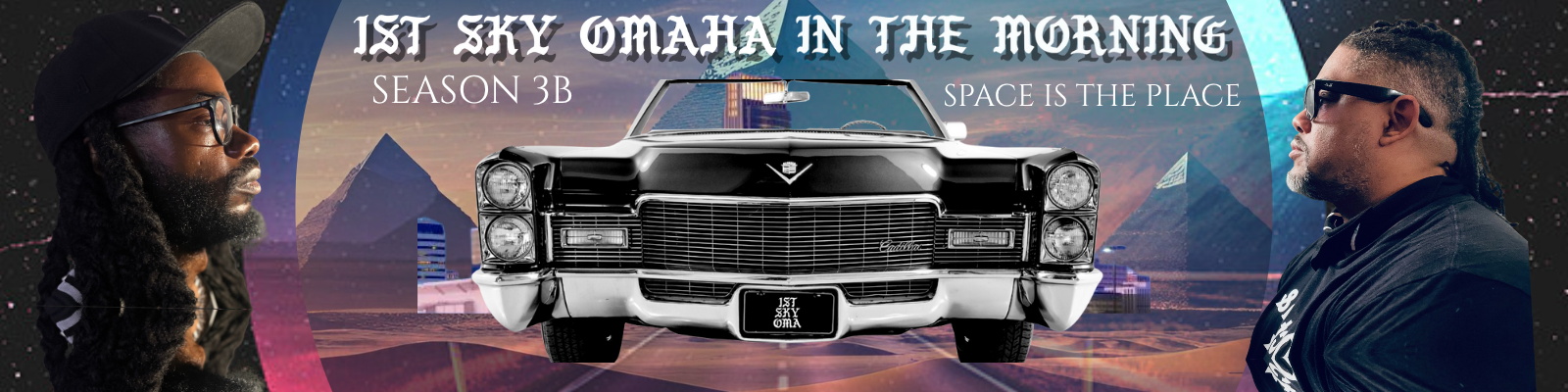
Friday mornings have a certain rhythm on 1st Sky Omaha in the Morning, and this past “Love Supreme Friday” was no exception. Hosts Paul B. and Buddy the God brought the warmth, the wisdom, and a guest whose vision for North Omaha is nothing short of transformative. Dana Murray — founder and executive director of the North Omaha Music Academy (NMA) — sat down with the crew to talk music, young people, and what it really takes to bring a community corridor back to life.
Before the conversation turned to music, the hosts took a moment to acknowledge the week’s primary election results and the emotions that come with them. Paul B. set the tone with characteristic grace: “We’re going to change our mindsets over to something else — it’s real easy to let your emotions take over when there’s so much to be emotional about. So let’s make a decision to change it up today.” Buddy the God added a pointed observation on civic participation: “None of this really matters if everybody voted. That’s a pretty valid point that kind of none of this — a lot of this — doesn’t matter if everybody voted.” Viewer Kimber Snipes chimed in from the chat with a compassionate counterpoint, writing that after conversations with people between the ages of 20 and 35, “what I hear the most is most of them don’t really know what to do and know nothing about the candidates,” and suggesting that more education and deeper discussions are needed before pointing fingers.
The show also paused to celebrate a community win — North Omaha entrepreneur Charell Shelton was recently awarded a $52,000 prize, the kind of news that reminds a neighborhood what’s possible when its people are recognized and resourced.
Then came Dana Murray, and the conversation shifted into something that felt both practical and inspired. Murray grew up in South Omaha, spent eleven years sharpening his craft in New York City, and came home to plant something lasting on North 24th Street. NMA — formerly known as Love’s Jazz — is a youth music academy and a live performance venue, and Murray has a clear-eyed sense of what the surrounding corridor needs to truly thrive.
“The area that can truly claim to be a cultural and arts district is the North 24th Street corridor,” Murray said. “But the community within has become so far removed from what that corridor once was that it’s hard to build momentum from within.”
He didn’t shy away from the nuts and bolts, either. Murray talked about the metrics any district needs — housing, parking, eateries, laundromats, entertainment, and yes, even a hotel, so that larger music festivals and conferences can anchor themselves right in the neighborhood. “There’s been a lot of stuff on North 24th Street that wasn’t sustainable,” he said, “and I can’t get caught up in the emotion of redevelopment without the X’s and O’s making sense.”
Paul B. has long held a particular reverence for that stretch of the city. “I’ve always called it the most important black corner in Nebraska,” he said. “We got to serve it. We have to be of service to it.” Viewer Pops brought that history alive from the chat, recalling that “artists like Fats Domino used to stay at your grandfather’s home when he came to town to perform,” adding that “more infrastructure for the artist around the Deuce corridor would be a godsend.”
Murray was equally candid about the broader opportunity North Omaha sometimes leaves on the table. While he expressed genuine love for events like Native Omaha Days, he called it “a failed opportunity to showcase our culture because it doesn’t invite the rest of Omaha to partake in what we have to offer.” His approach at NMA has been deliberately welcoming. “I’ve tried to be a beacon for all of Omaha to come down to North 24th Street,” he said, “and people don’t have any problem coming from wherever they are in Omaha or Iowa to come hear jazz music.”
At its core, NMA is about much more than music lessons. Paul B. described what he calls the “secondary matrix” — the deeper outcome beneath the surface skill. “In Dana Murray’s case, he teaches kids music — but the secondary matrix is to create critical thinkers, create people that can go further in their fields because they have the discipline of musical training and the mind-expanding benefits of musical training.” Murray put it plainly himself: “Not all these young kids are going to become musicians by choice — some will become doctors, lawyers, business owners — but whatever they choose to do, they’re going to be better because they were aligned with artistry.” Viewer Pops connected with that idea personally, writing that he experienced his own secondary matrix in junior high algebra — “I was gaining proficiency and noticed I was suddenly able to think outside the box on several different levels. Music the same.”
NMA also teaches live sound, broadcast, podcasting, and live streaming, putting professional tools directly in young hands. “We get kids doing interviews with artists so they understand they can do this right now,” Murray said. “It’s not rocket science. Once you remove those barriers, the sky is the limit.”
The future Murray envisions is ambitious: a full NMA campus, anchored by a $20 million first-phase capital campaign. He pointed to Omaha Performing Arts — which generates $40 to $50 million in revenue annually for its surrounding area — as a model for what intentional cultural infrastructure can do. “We need a vehicle like that for North Omaha, and I see NMA taking up that space,” he said. His closing thought was one of the morning’s most resonant: “Our culture is equity. Our brilliance, our artistic genius is equity — and the sooner we understand that and monetize it for our community, the better off we’re going to be.”
NMA is actively seeking music instructors who can do more than teach technique. Murray and his team can be reached at dmurray@northomahamusic.org or through assistant Andrew Bailey at abailey@northomahamusic.org. As Murray put it, the right instructor must have “in their arsenal the ability to inspire another human being.”
It was, by any measure, a Friday morning well spent — full of big ideas, community love, and the kind of honest conversation that makes 1st Sky Omaha in the Morning feel like home. Join Paul B., Buddy the God, and the whole First Sky family again Monday morning for another conversation worth waking up for.