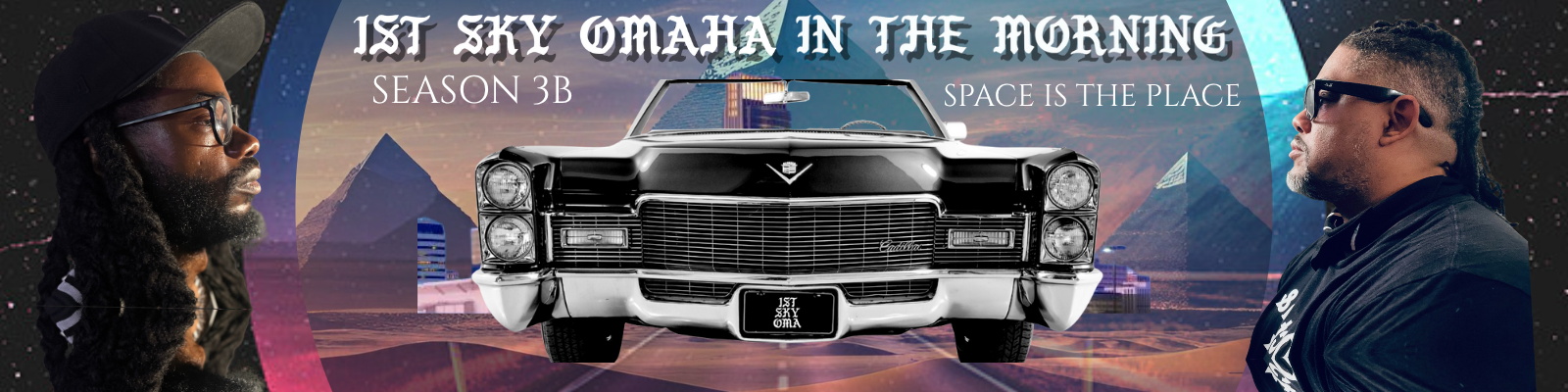
Friday mornings on 1st Sky Omaha in the Morning have a way of feeling a little different — and this past Friday was no exception. Hosts Paul B. and Buddy the God made a deliberate call at the top of the show to set the tone. “We talk a lot of politics,” Paul B. told viewers, “but today we’re making a decision — it’s going to be Love Supreme Friday. We’re going to change our mindsets over to something else.” And with that, the conversation turned toward music, community, and vision — anchored by a remarkable guest with deep roots and even deeper plans for Omaha’s North 24th Street corridor.
Dana Murray, executive director of the North Omaha Music Academy — formerly known as Love’s Jazz — joined the show for a wide-ranging conversation that covered everything from youth empowerment to economic development to the untapped cultural equity sitting right in North Omaha’s backyard. A musician and educator originally from South Omaha, Murray spent eleven years in New York City before returning home to build something lasting on the very street he considers sacred ground.
The vision Murray laid out for North 24th Street — affectionately known as “the Deuce” — was both practical and poetic. “Really, the area that has the most history and can truly claim to be a cultural and arts district is the North 24th Street corridor,” he said. “But we’ve been so far removed from what that was.” He painted a picture of old photographs showing a bustling Saturday morning street — people shopping, eating breakfast, men in their suits, a sense of togetherness that has faded over the decades. For revival to be real, Murray argued, it has to be built on sustainable infrastructure: housing, parking, laundromats, eateries, gas stations — and then destinations. “It would be great to have a hotel,” he said. “With a hotel, you can throw larger attractions, music festivals, conferences right in the community.”
Viewer Pops echoed the sentiment from the chat: “Artists like Fats Domino used to stay at your grandfather’s home when he came to town to perform. So yes, more infrastructure for the artist around the Deuce corridor would be a godsend.” It’s the kind of living community memory that gives Murray’s work its urgency.
Though Murray grew up in South Omaha, he pushed back on any notion that North Omaha’s story belongs only to those who were born there. “If you’re Black and you’re in Omaha, especially in the 70s and early 80s, North Omaha was the Mecca for all of us,” he said. He was equally candid about what he sees as missed opportunities — including what he described as a “false sense of security with pride” that sometimes keeps the community from opening its culture to the broader city. He pointed to South Omaha’s Cinco de Mayo celebration as a model: “They invite everybody down to be part of it.” Murray said NMA has tried to do the same. “People told me that was going to be very, very hard,” he said. “But people have no problem coming from wherever they are in Omaha or Iowa to come down to hear jazz music. That taboo about the area being an attraction was false. We’ve proven that.”
Viewer Derek Higgins weighed in simply and sincerely from the chat: “Congrats, Dana, and what NMA is doing.” The sentiment was widely shared.
At its core, North Omaha Music Academy is a youth music academy, a performance space, and — in Murray’s vision — a future economic engine for the neighborhood on the scale of what Omaha Performing Arts has meant for downtown. But the mission goes far beyond producing musicians. “We’re not only raising musicians,” Murray said, “but more importantly, we’re raising more critical thinking human beings.” Students can take electives in live sound, broadcast, and live streaming. There’s a broadcast lab where kids conduct actual interviews with artists. “It’s not just telling them they can be something,” Murray said. “No — you can be this right now.”
Paul B. framed this philosophy in terms he’s been developing throughout the season — what he calls the “secondary matrix.” “In Dana Murray’s case, he teaches kids music,” Paul B. explained, “but the secondary matrix is to create critical thinkers. Everybody’s not going to make it as a musician, but they become better at everything else because of musical training.” It’s a concept that resonated well beyond the conversation about NMA, touching on how community institutions can serve multiple layers of purpose at once.
Murray also spoke passionately about teaching students the history of Omaha’s own musical legends — figures like Buddy Miles and Victor Lewis — not as trivia, but as context. “If you give kids context, they connect the dots for themselves,” he said. “Now you’ve got a critical thinking human. That’s ultimately what we’re trying to do.”
Looking ahead, Murray shared that NMA is planning a capital campaign — with a first phase goal of $20 million — aimed at developing a full campus. “I see NMA taking up that space” of a cultural and economic anchor for North Omaha, he said. And he left viewers with a challenge that felt less like a rallying cry and more like a quiet truth: “What we have to sell in most Black communities is our culture. If we don’t monetize it — and 99% of the time we don’t — the rest of the country monetizes our culture for us. The sooner we understand that our culture is equity, that our artistic genius is equity, the better off we’re going to be.”
NMA is also actively hiring music instructors. Interested applicants can reach Dana Murray directly at dmurray@northomahamusic.org, or assistant Andrew Bailey at abailey@northomahamusic.org. Murray was clear that the right candidate isn’t just someone with technical knowledge — they have to be able to inspire. “The why they’re doing it is everything,” he said.
The show wrapped on a high note, with viewer Senator KML offering a heartfelt send-off from the chat: “Thank you, Uncle Dana. You’re changing lives in big ways. We are the students.” And viewer Aeros 402 (Mary Sanchez) reminded everyone what Love Supreme Friday is really about: “On a love note, my only daughter gave birth to my second granddaughter. They are both new and good. I feel blessed.”
That’s the spirit of this show — big ideas about culture and community, grounded always in the real lives of real Omahans. Tune in Monday morning for another conversation you won’t want to miss.