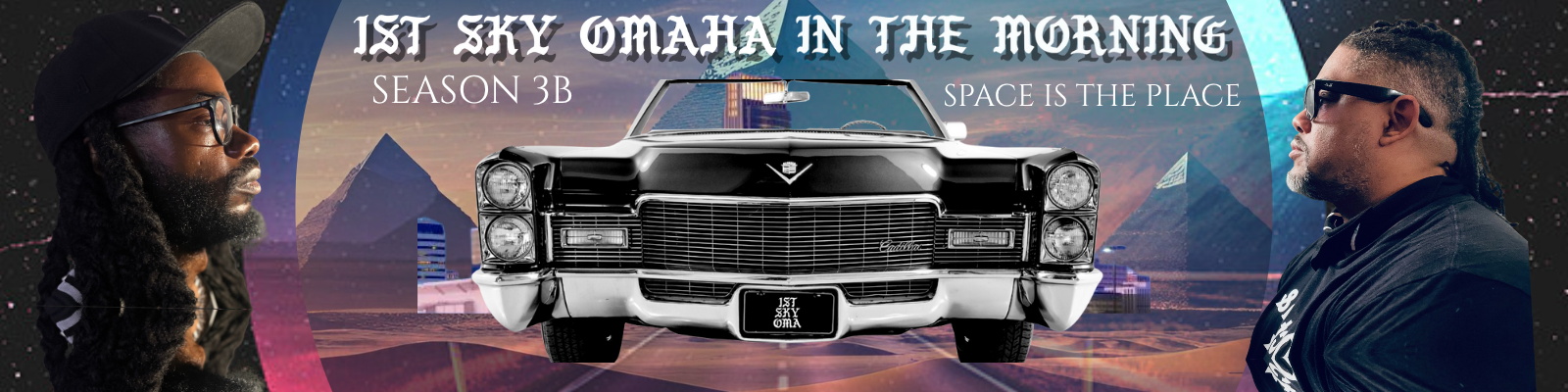
Friday mornings on 1st Sky Omaha in the Morning carry a particular kind of energy — and this past “Love Supreme Friday” was no exception. Hosts Paul B. and Buddy the God opened the show with a collective exhale after the midterm primaries, then quickly turned their attention to what they do best: shining a light on the people and ideas quietly shaping the future of Omaha’s north side.
“We’ve been talking a lot of politics for a while,” Paul B. said, setting the tone for the morning. “We purposely got some of the politics and things out of the way so we can continue on talking about how the next season’s going to shape up — which is teamwork makes the dream work.”
That spirit of collective forward motion threaded through the entire episode, including a candid conversation about voter participation. Paul B. referenced a post by Raquel Henderson noting that only 339,000 out of more than 1.2 million registered Nebraska voters cast ballots in the primary. “Think about that for a second,” he said. “And yet everybody has something to say. Posting on Facebook is not enough. Awareness without action changes nothing.” Viewer Kimber Snipes added important context in the chat, writing that in conversations with people between the ages of 20 and 35, “what I hear the most is most of them don’t really know what to do and know nothing about the candidates,” and suggesting that more education and deeper civic discussion are needed before communities can demand more from their voters.
But the heart of the morning belonged to Dana Murray, executive director and founder of the North Omaha Music Academy — known to many longtime Omahans as Love’s Jazz — nestled right on the North 24th Street corridor. A South Omaha native who spent eleven years in New York City before coming home to build something lasting, Murray brought the kind of quiet conviction that fills a room without raising its voice.
The conversation opened with the big picture. “The arts are the core of who we are as people — definitely as black people, and in the history of North Omaha and really Omaha,” Murray said. “With a lot of the development going on infrastructure-wise, very little is talked about the social, people development, healing that has to happen to even take advantage of all the opportunities.” He framed it plainly: “I just want us all to look at it as an equation — 2 plus 2 equals 4. There are things we have to do to move ahead, and oftentimes we get caught up in the emotion of building a community when we need some real X’s and O’s.”
Paul B. has a name for the deeper purpose underneath what NMA does. He calls it the “secondary matrix.” “Everything that we do has a secondary meaning, a deeper meaning,” he explained. “In Dana Murray’s case, he teaches kids music — but the secondary matrix is to create critical thinkers, create people that can go further in their fields because they have the discipline of musical training and the mind-expanding benefits of musical training.” Murray couldn’t have agreed more. NMA doesn’t just put instruments in young hands — it teaches them live sound engineering, podcasting, broadcasting, and how to interview visiting artists. “It’s not just telling them ‘you can be this someday’ — no, you can be this right now,” Murray said. “Once you remove those barriers, sky’s the limit.”
The conversation grew especially rich when it turned to history. Murray described how NMA teaches students about North Omaha legends like Buddy Miles and Victor Lewis — not as names to memorize, but as stories to inhabit. “They’re not just hearing someone say ‘Buddy Miles is from here and he used to play with Jimi Hendrix’ — that doesn’t mean anything to young people,” he said. “We’re teaching who Victor Lewis was, why he’s one of the most recorded jazz drummers in history. If you give kids context, they connect the dots for themselves.” Viewer Senator KML captured the feeling from the chat simply and powerfully: “Thank you, Uncle Dana. You’re changing lives in big ways. We are the students.”
Murray’s vision for North 24th Street — “the Deuce,” as it’s known — is bold and grounded in equal measure. He described a corridor that once buzzed with Saturday foot traffic, men in suits, corner shops, and a shared sense of culture and belonging. “It was a vibe,” he said. “There was a unity, a love, and a togetherness that was there because that’s all we had.” His blueprint for what it could become again includes essential infrastructure — housing, groceries, parking, laundromats — alongside cultural destinations like restaurants, entertainment venues, and even a hotel to anchor larger music festivals and conferences. Viewer Pops offered a personal thread to that history, noting in the chat that artists like Fats Domino once stayed at Paul B.’s grandfather’s home when coming to town to perform. “More infrastructure for the artist around the Deuce corridor,” Pops wrote, “would be a godsend.”
Murray also made a pointed case for how North Omaha presents its culture to the rest of the city. “Look at South Omaha’s Cinco de Mayo and how they champion their culture — it brings them together but they invite everybody to be part of it,” he said. “People had no problem coming from wherever they are in Omaha or Iowa to hear jazz music. That taboo about the area and its ability to be an attraction was false. We’ve proven that.” Viewer Mark Manor backed that up from experience: “When I go there it is the same people at shows at Waiting Room, Slow Down, and the Jewels. So people are coming from all around town and getting down at NMA, which I find impressive.”
Looking ahead, Murray announced that NMA is preparing to launch a capital campaign with a first phase goal of $20 million, with the long-term dream of a full NMA campus. “What we have to sell in most black communities is our culture,” he said, “because if we don’t monetize it — which 99% of the time we don’t — the rest of the country monetizes our culture for us. Every music in America has been built off of our experience, from the hardest rock music to the jazziest jazz. You trace it all the way back to the music brought over from Africa. That’s equity, and the sooner we look at it that way, the better we’re going to be.” Music educators interested in joining the NMA team can reach Murray at dmurray@northomahamusic.org or assistant Andrew Bailey at abailey@northomahamusic.org.
The show closed out with a round of community highlights worth noting. Buddy the God pointed to Charell Shelton’s Core Science Bio Diagnostics and the Heart Ministry Center’s new grocery store initiative as examples of the ecosystem-building the season has championed. The hosts also gave a strong recommendation to catch Boots Riley’s film I Love Boosters at Film Streams on May 22nd. And amid it all, the chat glowed with the warmth that makes this show feel like a neighborhood gathering — viewer Aeros 402 sharing that his daughter had just welcomed a new granddaughter, and viewer Marlon Harrison celebrating a cousin’s upcoming graduation from Kraton Prep this Sunday.
It was, in every sense, a Love Supreme Friday. If you missed it, make sure you’re up and tuned in next week — because on 1st Sky Omaha in the Morning, the conversation that matters most is always just getting started.